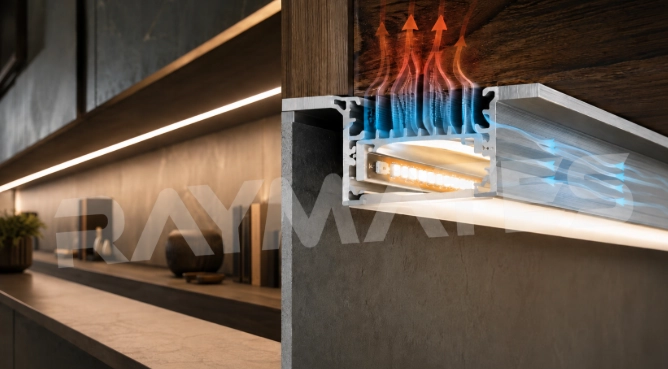
An LED Strip Aluminum Channel is often chosen for a cleaner installation, but its more important role is thermal and mechanical. Long operating hours can concentrate heat around the PCB, adhesive, solder joints, and nearby materials. For commercial projects, an Aluminum Profile should therefore be treated as part of the lighting system, not as decoration.
Raymates develops LED strip, COB strip, LED sheet, high-voltage strip, wall-washer products, accessories, and project-support services. Its ISO9001 system and pre-shipment testing support reliability-focused specification.
Why Does Heat Matter to the Long-Term Reliability of LED Strips?
The larger concern is accumulated thermal stress during repeated or continuous operation. In cabinets, shelves, display recesses, and architectural slots, limited airflow can make LED strip thermal management part of the initial design decision.
Heat Accumulation Creates Long-Term Component Stress
LED chips, solder joints, flexible PCB, adhesive, and protective materials work as one assembly. If heat remains concentrated, each part operates under greater thermal stress. Raymates treats thermal resistance, thermal management, lumen depreciation, and lifespan as connected COB performance considerations. Aluminum Channels are also listed as mounting and heat-dissipation accessories.
Thermal Management Supports More Stable Light Output
LED strip lifespan is not only about whether the strip still turns on. Buyers also need acceptable brightness, color consistency, stable mounting, and manageable service intervals. An aluminum profile for LED strip increases heat-spreading area, although the result still depends on profile size, contact, airflow, strip power, and ambient temperature.
Aging Tests Matter More Than a Lifespan Claim
A lifespan statement has limited value without long-term checks. Raymates uses aging-test equipment to simulate performance changes during extended operation, together with electrical and optical test instruments. For B2B sourcing, this is more useful than relying on an unverified nominal hour claim.
How Does an Aluminum Profile Improve LED Strip Heat Dissipation?
Heat moves from the LED and PCB through the mounting interface into the Aluminum Profile, where a larger metal surface can release it to surrounding air. The quality of that path depends on physical fit and installation.
A Larger Heat-Spreading Surface Reduces Local Heat Buildup
A led strip aluminum channel gives a narrow flexible PCB a broader heat-spreading surface. This is useful in recessed installations where the strip may otherwise sit against surfaces not selected for thermal performance. Good LED strip heat dissipation still requires close contact and secure fixing.
Enclosed Recesses Can Trap Heat Around the Aluminum Profile
An Aluminum Profile can spread heat away from the LED PCB, but it still needs somewhere to release that heat. In a narrow recessed channel, sealed cabinet, display niche, or other enclosed cavity, warm air may remain trapped around the profile. The aluminum then transfers heat effectively from the strip into the profile, while the surrounding structure becomes the next thermal bottleneck.
This is a thermal-resistance problem across the complete heat path rather than a defect in the profile itself. As operating time increases, heat can accumulate inside the cavity and raise the temperature of the LED strip, adhesive layer, connectors, and nearby materials. The risk is higher where airflow is restricted or where the profile is surrounded by materials that release heat slowly.
For this reason, an LED Strip Aluminum Channel should not be specified by width and appearance alone. In concealed installations, buyers and installers should also check cavity depth, available airflow, contact between the strip and profile, clearance around the Aluminum Profile, and whether heat can escape into the surrounding structure. If the installation is highly enclosed, reducing thermal resistance around the profile may be just as important as selecting the profile itself.
High-Density COB Strips Benefit From Planned Heat Management
Raymates’ Hot Selling COB Strip RM-COBW480-24V8L is listed at 480 LEDs/m, DC12V/24V, 10W/m with a 14W/m option, 8 mm width, CRI above 90, and a 180° beam angle. Its product page also describes use with a slim LED aluminum profile for recessed or surface-mounted linear lighting.
For this type of dense linear source, a COB LED strip aluminum profile should be considered during project design rather than added after installation problems appear.
Aluminum Profile Selection Must Match the Strip Structure
Raymates supports board widths from 3 mm to 30 mm across its flexible-lighting range. Check PCB width, power per meter, available depth, mounting orientation, diffuser clearance, waterproof construction, and operating duration. An Aluminum Profile that fits but provides poor contact is not a complete thermal solution.
What Does an Aluminum Profile Protect Beyond Heat Dissipation?
Flexible strips can also be affected by handling, uneven mounting, accidental contact, dust, and movement at connection points. A profile adds structure around the strip and makes the installation easier to protect and service.
Mechanical Protection Reduces Installation Damage
A led strip aluminum channel can shield the PCB from direct contact during cleaning, restocking, or routine maintenance. This matters in retail shelves, cabinets, and other accessible locations. Raymates also lists mounting clips, screws, brackets, end caps, connectors, and protective materials as parts of the strip-installation system.
Diffusers Improve the Finished Lighting Effect
A diffuser can reduce glare and make the light line appear smoother, but it cannot guarantee dot-free output by itself. LED density, channel depth, diffuser distance, and viewing angle still matter. COB strips already provide a more continuous emitting surface, so pairing them with a suitable Aluminum Profile is useful for visible architectural and cabinet lighting.
Secure Mounting Helps Preserve Long-Term Installation Stability
Adhesive alone does not suit every application. Curves, heat, dust, moisture, and temperature cycling can place extra demand on mounting. A structured profile gives installers more control and makes later replacement or inspection more predictable.
Which LED Strip Projects Need an Aluminum Profile Most?
A short decorative run has different requirements from a long commercial run, an enclosed cabinet, or a color-changing strip operating for hours. Match the profile to operating conditions.
Higher-Power and Long-Operating Lighting Needs More Thermal Control
Raymates’ Colorful LED Strip RM-5050RGBW96-24V12 is listed at 24V, 96 LEDs/m, 18W, and 12 mm width. The page also identifies copper FPC heat dissipation as a design consideration and recommends aluminum profiles for protection, heat dissipation, light distribution, and service-life support.
This is where an aluminum channel for high-power LED strips becomes a procurement issue, especially in architectural accents, signs, entertainment lighting, and enclosed installations.
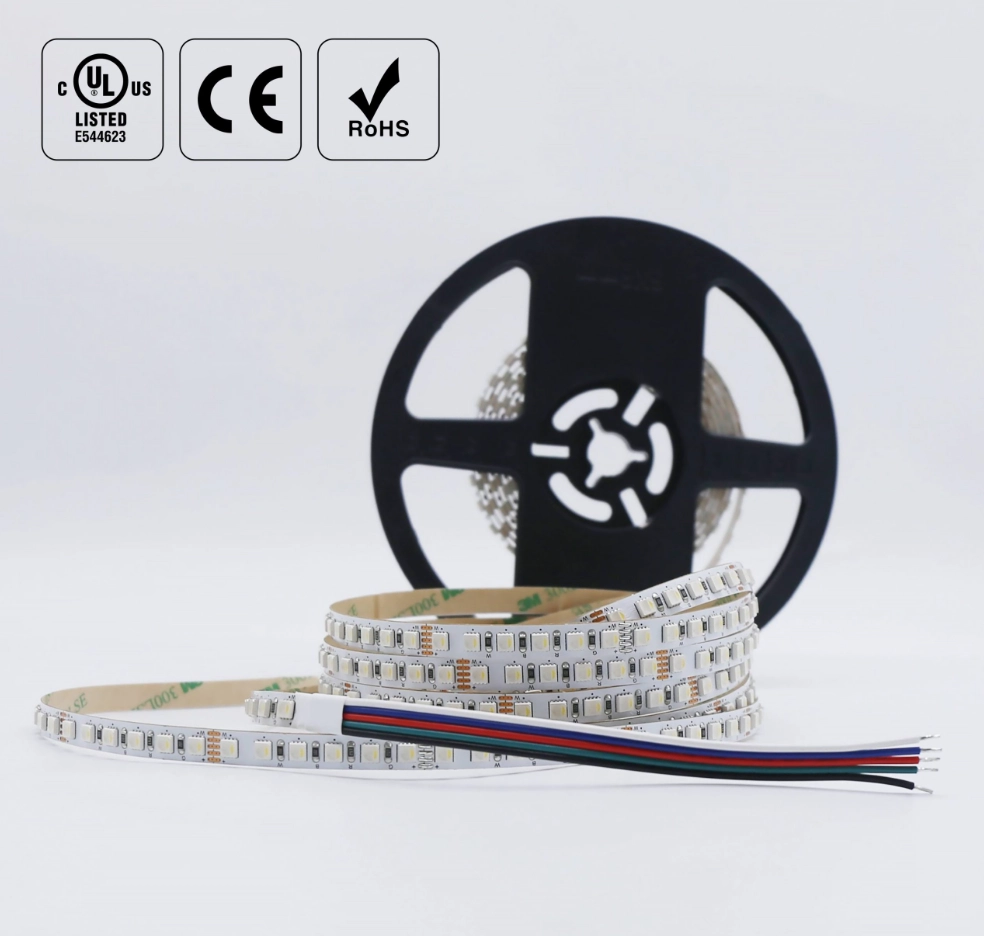
Visible Linear Lighting Benefits From COB Strip and Aluminum Profile Integration
For continuous linear light, buyers can compare the Raymates COB LED Strip range rather than select the strip and profile separately. The category includes several COB formats for different installation needs.
A practical sequence is strip, Aluminum Profile, diffuser, then driver and mounting accessories.
Continuous Commercial Use Requires Reliability-Based Selection
For commercial lighting, price per meter is only one factor. Operating hours, thermal environment, driver matching, moisture exposure, service access, replacement labor, and batch consistency can all affect maintenance. Raymates uses ISO9001 quality management, pre-shipment testing, and provides installation drawings, videos, and technical support.
How Should Buyers Specify an Aluminum Profile and LED Strip as a System?
Specification should start with project conditions. The led strip aluminum channel, PCB, driver, diffuser, fixing method, and environment should be reviewed together because changing one part can affect the others.
Match PCB Width, Power, Installation Space, and Operating Conditions
Before approving a sample, confirm PCB width, W/m, voltage, operating duration, profile depth, mounting surface, waterproof requirement, diffuser clearance, and wiring space. Raymates supports multiple voltage options, power customization, and 3–30 mm board widths, which makes this matching step important before volume purchasing.
Evaluate Reliability Before Comparing Purchase Price
A lower-cost channel or strip may be suitable in the right application. The mistake is comparing unit prices without considering replacement access, labor, downtime, or partial replacement. LED strip thermal management is easier to correct during specification than after profiles have been built into furniture, walls, or display systems.
Use Raymates Technical Service to Confirm the Complete Lighting System
Raymates can discuss project details, provide customized solutions, and prepare project or installation drawings. Buyers should provide strip type, PCB width, power, run length, mounting dimensions, operating hours, waterproof requirement, driver information, and preferred Aluminum Profile so the system can be reviewed before bulk ordering.
An LED Strip Aluminum Channel protects more than the appearance of a lighting line. It helps spread heat away from the PCB, adds mechanical protection, supports stable mounting, and works with the diffuser to improve the finished installation. The Aluminum Profile cannot guarantee a fixed lifespan on its own, because power, ambient conditions, driver selection, and installation quality still matter. Long-term reliability comes from specifying strip and profile as one system.
Project Support
If your project has limited channel space, long operating hours, higher strip power, unusual mounting surfaces, or uncertainty about PCB and diffuser matching, provide those constraints with the drawing or installation dimensions. Raymates can then discuss the strip, driver, accessories, and profile together through the contact page.
FAQ
Does every LED strip need an LED Strip Aluminum Channel?
No. Short decorative applications may work without one when the mounting surface and operating conditions are suitable. A channel becomes more valuable for long operating hours, enclosed spaces, higher power, visible linear lighting, or locations needing physical protection.
Can an aluminum profile really extend LED strip lifespan?
It can support more stable service by improving heat spreading and protecting the strip, but it is not a standalone lifespan guarantee. Power density, ambient temperature, PCB design, driver matching, mounting contact, moisture, and operating hours also affect reliability.
How do I choose the right LED Strip Aluminum Channel for a COB strip?
Start with PCB width, strip power, available profile depth, diffuser clearance, wiring space, mounting method, and operating environment. For visible linear lighting, also check whether the profile and diffuser geometry produces the required light uniformity before final approval.