For OEM buyers, LED Strip Light Specs are more than a list of electrical values on a datasheet. Voltage, power, lumen output, CCT, CRI, LED density, PCB width, waterproofing, and cutting length all affect how a strip performs after it is built into a cabinet, retail display, hotel fixture, architectural profile, or other finished product. A strip that looks suitable on wattage alone may create problems with driver sizing, fixture fit, color consistency, or installation length.
Raymates manufactures LED strip products for commercial, residential, and OEM applications. Its available product range covers multiple low- and high-voltage configurations, while PCB widths across the broader range extend from 3 mm to 30 mm. Raymates also supports customized power and lighting configurations for different project requirements. For buyers comparing an LED strip manufacturer for bulk production, the useful question is not simply which strip is brighter, but whether the complete specification matches the product being built.
Which LED Strip Light Specs Should OEM Buyers Compare First?
A useful OEM comparison starts by separating electrical, optical, mechanical, and environmental specifications. This makes OEM LED strip specifications easier to compare and prevents one impressive number from hiding a weakness elsewhere.
Electrical and Optical Specs Define Baseline Performance
Start with voltage, wattage per meter, lumen output or luminous efficacy, CCT, and CRI. Standard LED terminology also includes current, driver type, beam angle, and IP rating.
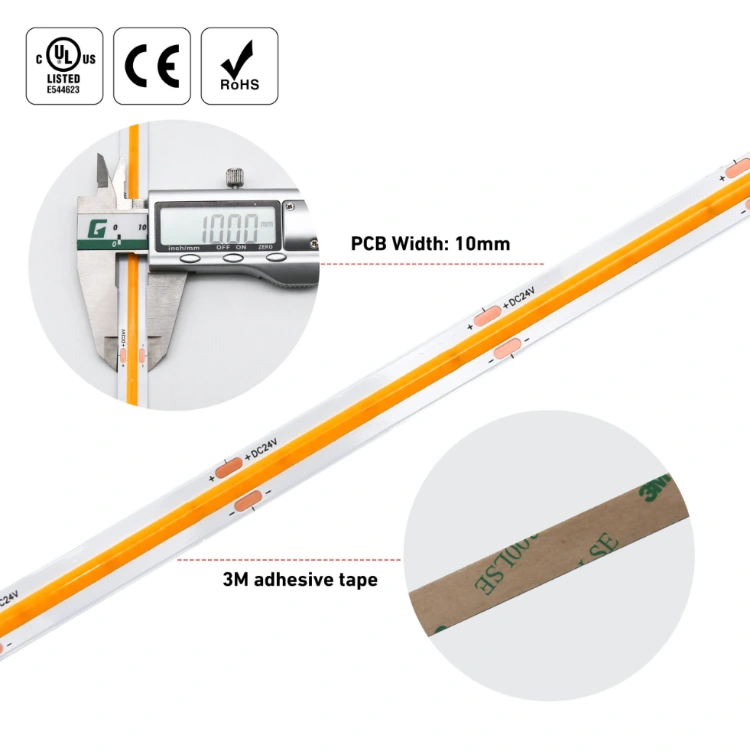
For example, the Hot Selling COB Strip has 12V and 24V options, a reference power of 10W/m with a 14W/m option, 480 LEDs/m as its main density, 90–120 lm/W, a 180° beam angle, and CRI above 90. It also offers different waterproof treatments. These led strip light specs make it useful as a reference for buyers evaluating a 24v cob led strip light for linear commercial fixtures, hotel lighting, or cabinet lighting.
Physical and Environmental Specs Determine Product Fit
PCB width, cutting pitch, waterproof structure, adhesive method, connectors, and mounting profiles affect what happens during assembly.
Raymates’ wider LED strip range covers PCB widths from 3 mm to 30 mm. This matters for OEM products because a strip that is electrically suitable can still be unusable if it does not fit inside the extrusion or housing.
The LED Strip S3/S5 Series gives buyers several physical formats. S5 uses SMD5050 configurations with 8, 10, 12, or 15 mm PCB options and different LED quantities, while S3 includes narrower 8 and 10 mm options. The series also offers IP20 through several IP65, IP67, and IP68 configurations. This type of flexibility is useful for bulk led strip lights used across several fixture families.
Compare Raymates LED Strip Options Side by Side
The table below shows why OEM LED strip specifications should be compared as a set rather than one parameter at a time.
| Product | Brightness / Efficiency | CCT | CRI | Voltage | LED Density | Waterproof Rating | PCB Specification |
| Hot Selling COB Strip | 90–120 lm/W | 3000K / 4000K / 6000K | >90 | 12V / 24V | 480 LEDs/m; other options available | IP20; IP65/IP67/IP68 options | 8 mm reference model |
| LED Strip S3/S5 Series | Depends on configuration | Depends on configuration | Confirm selected configuration | 12V / 24V | S5: 30/48/60/72/96/120 LED options; S3 3535: 120 LEDs/m | IP20 to multiple IP65/IP67/IP68 configurations | S5: 8/10/12/15 mm; S3: 8/10 mm |
| Mini Size COB Strip | 80–90 lm/W | 3000K / 4000K / 6000K | 90 | 5V; 3V/12V/24V options | 480 LEDs/m | IP20 | 3 mm; 2.5/4/5 mm options |
| Super Long COB Strip | 680 lm/m; up to 100 lm/W stated | 2700K; 3000K/4000K/6000K options | >90 | 24V reference; extended configurations available | 480 LEDs/m | IP20 standard; waterproof customization available | 10 mm reference |
The Hot Selling COB Strip specifications come from its product configuration. The Mini Size COB Strip lists its narrow PCB, optical, voltage, and IP data directly in its specification table. Super Long COB Strip provides its standard 24V, 480 LEDs/m, 10 mm PCB, 10W/m, and 680 lm/m configuration.
How Do Voltage, Power, and Run Length Affect OEM System Design?
LED strip voltage and wattage must be evaluated together with total installation length. For wholesale led strip lights, ignoring this relationship can create unnecessary feed points, oversized wiring, uneven output, or driver-selection problems.
Voltage and Wattage Must Match the Driver and Run Length
Raymates supports multiple low-voltage options across its range, including 3V, 5V, 12V, 24V, 36V, and 48V, as well as high-voltage configurations for other applications.
A buyer specifying LED strip voltage and wattage should therefore provide total run length and installation layout, not just ask for “24V LED strip.” The same wattage per meter creates a very different total system load at 2 meters and 20 meters.
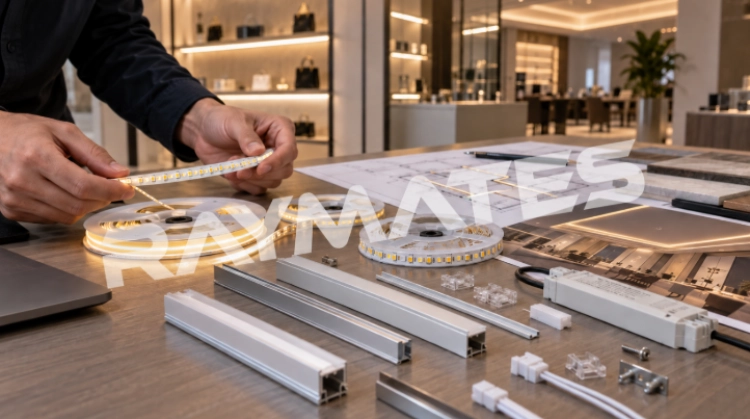
Power supply, controller, connectors, extension cables, mounting clips, and aluminum channels are also part of the installation system, not afterthoughts.
Long Runs Need a Voltage-Drop Strategy
For long run LED strip lighting, the feed arrangement and conductor design become increasingly important.
The Super Long COB Strip uses 480 LEDs/m and is designed for extended continuous installations. Its standard table lists 24V, 10W/m, a 10 mm PCB, and a 20 m roll. It fits projects such as architectural contours, corridors, shelf lighting, signage, and other applications where reducing repeated power connections can simplify installation.
Raymates has also applied long-run LED strip principles in a bridge perimeter project using a high-voltage warm-white strip with a maximum 50 m illuminated run. That project is a useful reminder that run length should be decided before the electrical layout.
For further planning, Raymates’ article How to Calculate the Perfect Length of Long LED Lights for Any Room can support the early measurement stage before power architecture is finalized.
Driver Headroom and Power Planning Reduce Field Problems
Driver selection should account for the total strip load rather than one-meter ratings. This is especially relevant to long run LED strip lighting, industrial led strip lights, and large commercial installations where several sections may share a power architecture.
The practical sequence is simple: establish run length, calculate total connected wattage, confirm voltage, define feed points, and then match the driver and controls. These checks belong beside the other led strip light specs on the RFQ.
How Do Light Quality Specs Change the Final Visual Result?
Two LED strips can use the same voltage and wattage while producing noticeably different results. For retail display, hotel lighting, under cabinet strip lighting, and architectural lighting, optical specifications often decide whether the finished installation looks consistent.
Lumens and Luminous Efficacy Should Be Read Together
Lumens describe light output, while luminous efficacy expresses light output relative to electrical power. Both are recognized LED performance parameters.
This distinction matters when comparing led strip light specs. A high lumen-per-meter figure may suit task lighting, but an OEM building hundreds of fixtures must also consider system power and thermal conditions.
A phrase such as High Lumen COB LED Strip for Hotel Lighting therefore needs supporting values, not just a brightness claim. For procurement, compare lumen output, lm/W, wattage, and installation conditions together.
CCT and CRI Must Match the Application and Batch Requirements
CCT defines the appearance of white light, while CRI helps buyers judge how naturally illuminated objects will reproduce color. LED strip specification ranges commonly cover warm through cool white, and Raymates’ technical terminology includes both CCT and CRI as core selection parameters.
For a high CRI COB LED strip used in retail displays, wardrobes, hotels, or product presentation, CRI should be reviewed alongside CCT and batch color consistency. A nominal 3000K label alone does not tell a buyer how consistent multiple production batches will appear when installed side by side.
LED Density and Light Uniformity Affect Dot-Free Performance
Higher density can reduce visible spacing between light-emitting points, but density is not a standalone quality grade. Power density, PCB design, thermal path, diffuser distance, and fixture geometry also matter.
The Hot Selling COB Strip uses a 480 LEDs/m reference configuration and continuous COB emission. For a high CRI COB LED strip used as a visible linear light source, that structure can help where a dotted appearance would be undesirable.
Which Physical and Environmental Specs Should Be Matched to the Installation?
Mechanical fit and environmental exposure are often the difference between a good sample and a successful production run. This is especially relevant to a waterproof LED strip for commercial projects, narrow furniture profiles, outdoor strip lighting, and built-in OEM products.
PCB Width and Strip Form Factor Control Fixture Compatibility
For narrow profiles, PCB width should be confirmed before tooling or extrusion dimensions are frozen.
The Mini Size COB Strip has a 3 mm reference width with 2.5, 4, and 5 mm options. It uses 480 LEDs/m, and its reference configuration is rated at 80–90 lm/W with CRI 90.
This makes it relevant to buyers searching for a 5mm led strip or 5mm cob flexible led strip light for display cases, narrow grooves, product interiors, wine cabinets, or compact under cabinet strip lighting.
IP Rating Should Follow Exposure rather than “More Is Better”
An IP rating should match the installation environment. A sealed strip can be necessary for outdoor strip lighting, but additional encapsulation may be unnecessary inside a dry protected fixture.
For a waterproof LED strip for commercial projects, buyers should define whether the product faces occasional moisture, direct outdoor exposure, or a protected indoor environment. The LED Strip S3/S5 Series supports multiple IP20, IP65, IP67, and IP68 configurations, allowing the environmental requirement to drive selection.
Cutting Pitch, Connectors, and Mounting Affect Installation and Maintenance Cost
Cutting pitch determines how closely a strip can match the fixture’s required length. Connector type affects assembly time, while aluminum profiles can support installation and heat management.
Raymates’ LED strip accessory system includes connectors, extension cables, mounting clips, channels, end caps, and power supplies. For buyers ordering bulk led strip lights, these details can reduce field soldering and simplify replacement.
What Should OEM Buyers Confirm Before Approving a Supplier?
The final sourcing decision should move beyond a sample that simply lights up. Buyers comparing a led strip manufacturer need a repeatable specification that can be carried from sample approval into mass production.
Turn the Project Brief into a Specification and Sample Checklist
A useful RFQ should state voltage, wattage per meter, target brightness, CCT, CRI, PCB width, LED density, IP requirement, run length, cutting pitch, driver type, control method, and expected application.
Raymates Customize supports adjustments such as color temperature, strip length, voltage, power, private molds, branding, and packaging. This is particularly relevant when standard led strip light specs do not fit the housing or production process.
Check Compliance, QC, and Batch Consistency Before Mass Production
Sample approval should include electrical function, color, dimensions, assembly fit, and labeling. For wholesale led strip lights, consistency between the approved sample and later production batches matters as much as the initial sample result.
Raymates operates with an ISO9001 quality system and conducts inspection before shipment. Its product compliance portfolio includes UL, ETL, CE, RoHS, and TUV.
Use Raymates Customization and Contact Support for Final Matching
A buyer sourcing an OEM LED strip specification should send the actual fixture dimensions, required run length, voltage, target light output, color requirement, environmental exposure, and annual quantity. Raymates provides customized LED strip solutions as well as installation guidance and online support.
If your project involves a narrow profile, long continuous run, waterproof installation, retail fixture, or unusual electrical requirement, prepare the drawing and target LED Strip Light Specs before sampling. You can contact Raymates with the application, dimensions, target parameters, and expected order quantity so the technical discussion starts from the actual product rather than a generic strip description.
FAQ
Which LED Strip Light Specs Are Most Important for OEM Buyers?
Start with voltage, wattage per meter, lumen output, CCT, CRI, PCB width, LED density, IP rating, cutting pitch, and maximum intended run length. Then check driver and connector compatibility. The right priority depends on the fixture: a retail display may place more emphasis on CRI and color consistency, while a compact device may be limited first by PCB width.
Is 12V or 24V Better for Long LED Strip Runs?
Neither voltage is automatically better for every project. For long run LED strip lighting, total length, wattage, conductor design, feed points, and driver arrangement should be considered together. A 24V system can be useful for longer installations, but the actual permissible run should always be confirmed for the selected strip rather than assumed from voltage alone.
What IP Rating Should I Choose for a Commercial LED Strip Project?
Match the rating to the actual exposure. Dry indoor fixtures may not require the same protection as humid areas or outdoor strip lighting. For a waterproof LED strip for commercial projects, specify where the strip will be installed, whether it faces direct moisture, and how connectors and cut ends will be protected.