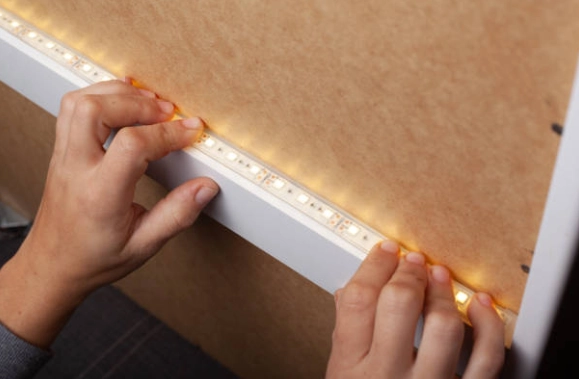
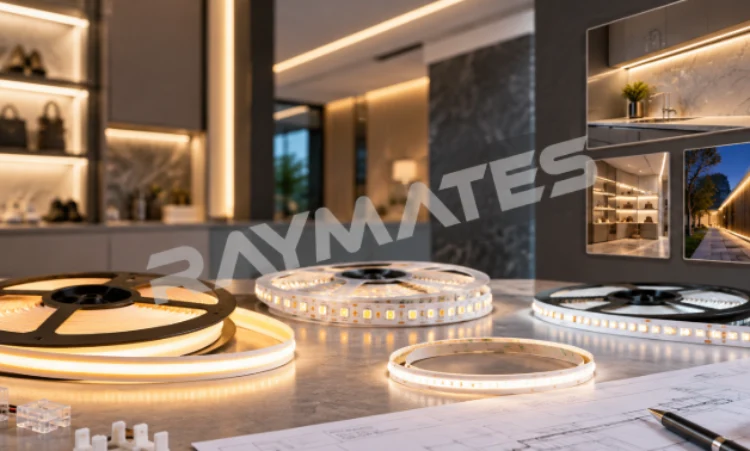
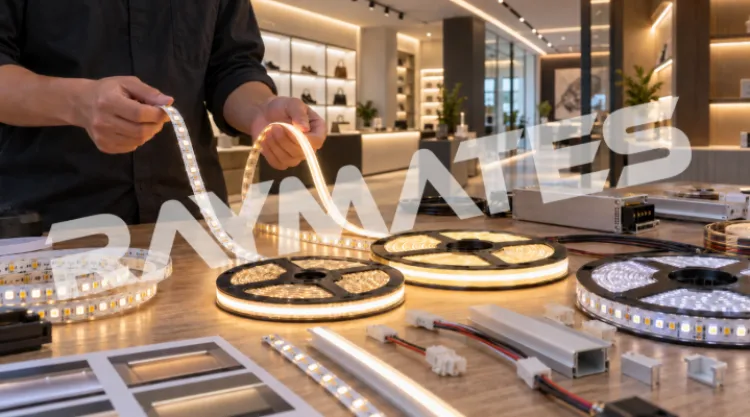
LED Strip Lights look simple from the outside, but the final lighting effect depends on chip layout, circuit design, voltage, power supply, control method, installation surface, and strip length. For buyers, the real question is not only how the strip turns on. It is whether the strip can keep stable brightness, fit the space, match the driver, and avoid visible light spots after installation.
Raymates manufactures LED lighting products for residential, commercial, decorative, and project use, including COB strips, LED strips, digital strips, high voltage strips, LED sheets, and related accessories. Its product range covers low-voltage and high-voltage options, different board widths, customization needs, and project support. That makes the working principle easier to connect with real selection decisions.
How Do LED Strip Lights Actually Work
A strip light is a small self contained lighting system, mounted on a flexible printed circuit. Strip lights are often misunderstood as simply a row of lamps. In reality, the performance of a strip light is greatly affected by the chip, board, driver, controller, connector and method of mounting.
LED Chips Convert Electricity Into Light
Each LED chip emits light when electrical current passes through its semiconductor material. In regular strip designs, individual LED packages are mounted along the strip. In COB designs, multiple chips are arranged closely under a continuous light-emitting layer. This is why COB strip products can give a smoother line of light in close-view applications.
Where the strip is visible, for the buyer of a chip in a strip, the layout of the individual chips is the most important consideration. This would be along display shelves, along edges of cabinets, along grooves in woodwork, along the bar in a hotel, along stairs, along retail counters etc.
PCB Carries Power and Supports the Circuit
The PCB is the base that carries power through the strip and supports the mounted chips. A flexible PCB allows the strip to bend along straight lines, corners, curves, and narrow spaces.
For project-grade LED Strip Lights, the FPC substrate is not only a carrier for the LED chips. It also affects current stability, bending reliability, and heat transfer. A double-layer rolled-copper FPC design can provide a more stable conductive path than a thin single-layer structure, especially when the strip is bent, cut, or installed across a longer visible line. Rolled copper also has better flexing behavior than ordinary copper foil, so it is more suitable for curved grooves, cabinet edges, furniture outlines, and other installations where the strip may be pressed or slightly bent during assembly. From a thermal design point of view, the copper layer helps spread heat along the strip instead of leaving heat concentrated around each chip. For buyers, this means PCB structure should be checked together with voltage, power density, installation surface, and profile design, not treated as a minor detail.
Raymates offers different board width options across its strip products, which helps buyers match compact grooves, wider profiles, or project-specific layouts.
A narrow board can solve space problems, but it also needs proper power matching and installation support. A wider board may be easier to handle in some linear projects.
Power Supply and Controller Manage Output
The LED strip power supply converts building power into the voltage needed by the strip. A controller adjusts brightness, color, or dynamic effects when the strip supports those functions. Connectors, extension cables, splitters, mounting clips, aluminum channels, end caps, and remote controls are also part of the system.
This is why procurement should not focus only on the strip roll. A stable project normally needs the strip, matching driver, correct connector, suitable fixing method, and enough heat control.
What Factors Affect the Performance of LED Strip Lights
A strip that is very suitable for use in a display case is not suitable for a long corridor, for a bridge outline or for a narrow groove in furniture. The choice of a strip starts with the electrical and the installation conditions and then the light effect.
Voltage, Power, and Board Width Selection
We support the low-voltage power options of 3V, 5V, 12V, 24V, 36V and 48V and the high-voltage power options of 110V, 120V, 220V and 230V. All of these power options are supported because different markets and different projects use different power systems.
For most indoor applications, such as bars, entertainment units, recessed, 12V or 24V LED strip lights are the most common form of lighting as they are easy to control and safe for small areas. For longer runs or larger areas, it is important to consider the voltage drop, the driver capacity, the wire length and the method of connection.
Brightness, Heat, and Light Uniformity
Brightness is not just about the wattage of the LED. The density of the chips, the quality of the PCB, the design of the diffuser, the voltage stability and heat dissipation are all critical factors to achieve the expected brightness. A power supply that is too small can cause the strips to dim. Long runs of LEDs without proper design can also cause the far end to appear weaker then the rest.
For commercial spaces, uniformity often matters more than maximum brightness. Retail shelves, counters, signage, and hotel decorative lines usually need a clean light surface without obvious dots or dark sections.
Color Quality and Control Method
Color quality of products, materials and surfaces is how they look. Our product information and technical terms to explain to buyers such as CRI, color temperature, RGB/RGBCCT, PWM dimming, 0-10V dimming, DMX, SPI, smart control, etc. By using these terms buyers can discuss their projects with the right supplier.
A simple warm white strip may be enough for a home cabinet. A club, showroom, or entertainment space may need color-changing control. A commercial project may need dimming stability and consistent color across batches.
Why Do COB LED Strip Lights Look More Uniform
COB strip design is often selected when users want a clean, continuous light line. The structure reduces the visible gap between light points, especially when the strip is installed close to the viewer.
Chip-on-Board Structure for Dot-Free Light
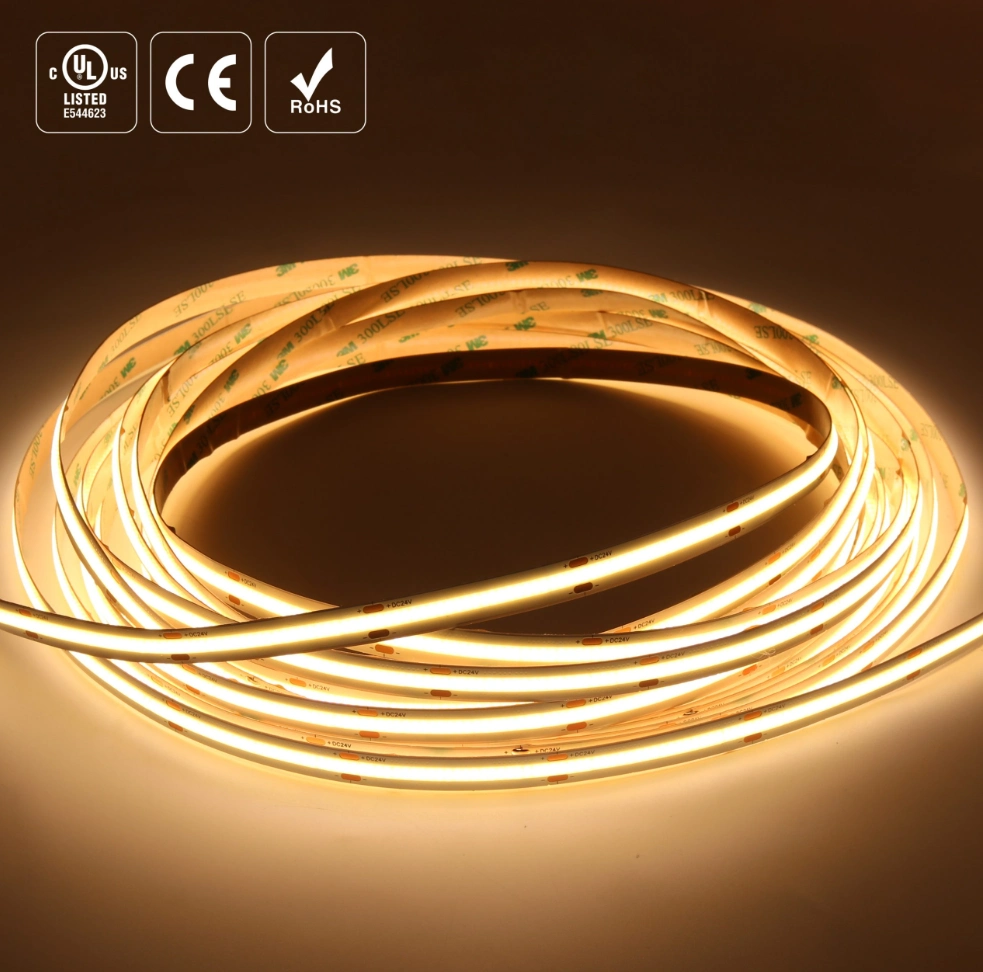
COB means chips are arranged directly on the board and covered by a continuous phosphor or encapsulation layer. Instead of seeing separate LED points, the viewer sees a more connected light surface. This is the basic reason a dot-free LED strip is useful for decorative grooves, display furniture, and close-distance linear lighting.
Better Fit for Decorative and Commercial Lines
COB strip products are ideal for visible designs for hotels, bars, counters, signs, cabinets and furniture outlines. A dotted line can give the impression of an unfinished project. Our COB strip products can help prevent this without the need for a deep aluminum profile or a thick diffuser.
Less Visible Spotting in Close-Range Viewing
Spotting of small imperfections can be noticed more when the strip is placed near the eye or when light is reflected from shiny surfaces such as marble, glass, polished metal, acrylic or display shelves. In such cases a COB LED strip will provide a cleaner look than most other strip arrangements that buyers have come to expect.
Which Type of LED Strip Lights Should You Choose
The right strip depends on color effect, run length, available space, and installation environment. Raymates has several COB products that fit different project needs.
Colorful COB Strip for Dynamic Color Effects
The colorful cob strip is suitable when the project needs changing colors or stronger decorative atmosphere. This strip is used for entertainment spaces, for displays in retail stores, for themed interiors, for outlining furniture and for background lighting.
This type of light can be useful to customers who require white light but also wish to have color effects to create ambiance, branding or even display purposes.
Super Long COB Strip for Long Continuous Runs
The super long cob strip is designed for longer continuous lighting runs. Raymates product information for long running options with reduced voltage drop, constant current design, high chip density, CRI over 90, and waterproof options for your project needs.
A long run LED strip is used for long corridors, long display lines, architectural outlines, shop ceilings etc. where frequent power injection points are not required. Buyer must confirm total length, voltage, power supply, how you intent to route the strip and required waterproofing rating before purchasing.
Mini Size COB Strip for Narrow Installation Areas
The mini size cob strip fits narrow grooves and compact layouts. Raymates product information lists small width options and use cases such as display case lighting, cove lighting, stairs, smart toilets, and deep groove edges.
A mini COB strip helps when the lighting channel is too tight for a standard strip. It is also useful for furniture factories, cabinet makers, and designers who need a slim light source without obvious light dots.
How Can Buyers Reduce Installation and Maintenance Problems
Many problems appear after installation because voltage, driver capacity, connector type, adhesive method, or heat path were not checked early. Good selection reduces rework.
Match Voltage, Driver, and Strip Length Before Ordering
Before purchase, confirm voltage, total length, wattage, wiring route, control method, and whether the strip will be cut on site. Do not assume one driver can power any strip length. Mismatched voltage or insufficient power capacity can cause dimming, flicker, heat, or early failure.
Use Proper Connectors, Adhesive, and Aluminum Profiles
Connectors should match strip width and type. Adhesive should match the mounting surface. Aluminum profiles can help with fixing, protection, diffusion, and heat control. End caps and waterproof treatment are also needed for outdoor or humid areas.
For project orders, these accessories should be planned with the strip instead of added later.
Ask for Project Support, Customization, and Testing
Raymates provides customization, installation guidance, product testing before shipment, and support for project drawings or installation notes. For buyers handling commercial or OEM work, this reduces communication gaps between design, procurement, and installation teams.
Conclusion
LED Strip Lights work through the coordination of LED chips, PCB circuits, power supply, controller, and installation accessories. The right type depends on where the strip will be installed, how long it needs to run, whether the light line is visible, and what color or control effect the project needs. For colorful decorative scenes, consider colorful cob strip. For long linear projects, look at super long cob strip. For tight grooves and small spaces, mini size cob strip is easier to fit.
If your project involves uncertain voltage, narrow channels, color control, long-distance wiring, waterproof installation, or batch customization, share the layout, length, voltage, and application notes through Raymates contact. Clear project information helps the engineering and sales team recommend a strip, driver, accessory set, and installation method that match the real site.
FAQ
Q: How do LED Strip Lights get power?
A: They use a power supply or driver that converts input power into the voltage required by the strip. The driver must match the strip voltage, total wattage, and installation length.
Q: Are COB strips better than regular LED strips?
A: COB strips are better for smooth, close-view light lines because the chips are arranged more densely under a continuous emitting layer. Regular strips may still work well where the strip is hidden or used with a diffuser.
Q: What should I check before buying LED Strip Lights for a project?
A: Voltage, total length, power supply required, board width, color, dimming, water resistant, surface to be installed on, how many sections to cut, required accessories.