A sample that lights up is not automatically ready for bulk production. An OEM/ODM LED Strip Manufacturer should verify electrical, optical, mechanical, environmental, and construction requirements before approving a production version. For buyers, LED strip sample testing turns project requirements into measurable acceptance criteria before faults become batch problems.
Raymates combines LED strip manufacturing, OEM/ODM work, laboratory verification, and production inspection. Its product system covers low- and high-voltage options, customized power requirements, and different PCB widths. The company applies ISO9001 quality management and inspection before shipment. The key question is whether the selected specification can be tested, approved, and repeated in production.
What Should Buyers Confirm Before LED Strip Sample Testing Begins?
Testing without a fixed specification produces ambiguous results. Before an oem/odm led strip manufacturer sends a sample to the laboratory, the buyer and engineering team should agree on voltage, power, PCB width, CCT, CRI, waterproof structure, cut length, control method, connector type, and installation conditions.
Lock the Sample Specification Before Testing
Raymates supports low-voltage options from 3V to 48V and high-voltage options from 110V to 230V, along with power customization and board widths from 3 mm to 30 mm. One generic test sheet cannot cover every project.
A narrow strip may need tighter dimensional checks, a waterproof strip needs sealing and environmental checks, and a long run needs electrical checks at more than one point. The test sheet should follow the approved specification.
Match the COB Strip Type to the Application
The COB LED Strip range includes Hot Selling COB Strip, Mini Size COB Strip, Mini Cut COB Strip, Colorful COB Strip, and Super Long COB Strip.
Mini Size COB Strip suits limited channel space. Mini Cut COB Strip requires attention to cut points and continuity. Colorful COB Strip needs channel and color-function checks, while Super Long COB Strip should be reviewed for electrical behavior and visible consistency along the run.
Define Acceptance Criteria Before the Test Starts
Record the sample number, specification version, application, test date, and required configuration. Fix acceptance criteria before reviewing results so engineering, QC, sales, and production work from one reference.
Which Laboratory Tests Should Be Performed on LED Strip Samples?
LED strip laboratory testing should move from electrical behavior to optical output, dimensions, construction, and application-specific checks. Abnormal current or wiring should be found before a sample proceeds to longer tests.
Verify Electrical Performance Before Measuring Light Output
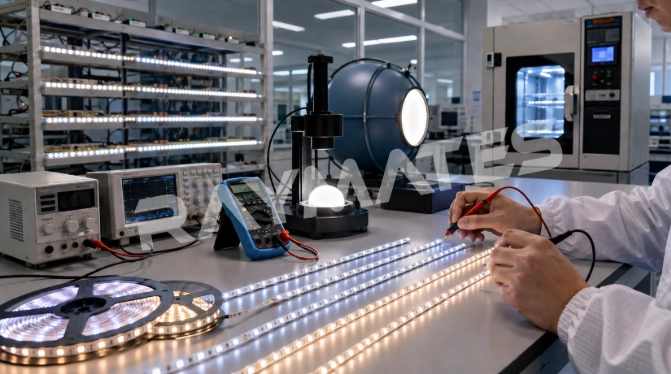
Start with the rated input condition. Measure voltage and current, verify power consumption, inspect polarity, and check continuity at solder joints and connectors. Multimeters can expose open circuits, inconsistent voltage, or abnormal current that visual inspection may miss. If readings are abnormal, an oem/odm led strip manufacturer should correct the cause before sample approval.
Measure Optical Output and Color Consistency
Once electrical behavior is stable, check luminous output, CCT, CRI, color consistency, and light distribution. For RGB or multi-channel products, test each channel rather than judging only a mixed-color effect.
Raymates’ Laboratory Display includes an Integrating Sphere and IES Laboratory used before mass production, allowing results to be recorded instead of judged only by eye.
| Test Item | What to Verify | Purchase Risk Controlled |
|---|---|---|
| Voltage and current | Approved operating condition | Circuit or loading errors |
| Power | Actual input versus specification | Driver and thermal mismatch |
| CCT and CRI | Color target and rendering | Visible installation mismatch |
| Light consistency | Sections or samples | Batch appearance variation |
| Dimensions | PCB width and cut points | Installation problems |
Inspect Dimensions Mechanical Strength and Construction
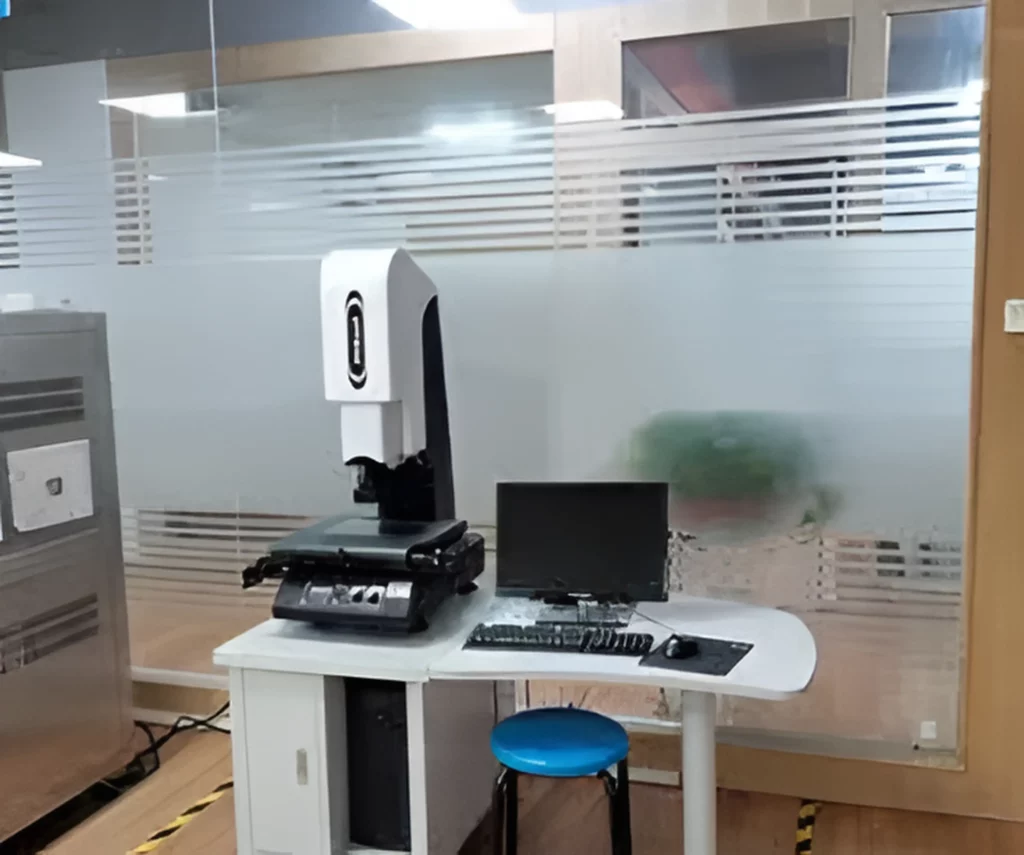
Measure PCB width, total strip dimensions, cutting position, and connector placement. Inspect solder joints, flexible substrate, encapsulation, end treatment, and adhesive condition.
For narrow or frequently cut COB products, dimensional error can cause assembly problems even when the strip works on the bench. Bending or tensile checks are useful where strips will be routed around curves.
How Should Reliability Testing Expose Problems Before Bulk Production?
A new sample can pass its first measurement and still change after heat, moisture, UV exposure, mechanical stress, or extended operation. Reliability testing should match the real application.
Use Aging Tests to Check Performance Stability
A practical LED strip aging test starts with baseline electrical and optical readings. Operate the strip under the defined condition, monitor stability and temperature, then measure it again to see whether performance shifts outside the approved requirement.
For longer COB strip configurations, check different positions along the run. An oem/odm led strip manufacturer can then compare the beginning, middle, and end instead of assuming one point represents the whole installation.
Test Temperature Humidity UV and Waterproof Resistance
Raymates’ laboratory equipment includes a Temp&Humi Test Chamber, UV Weathering Test Box, IPX8 Flooding Pressure Testing Machine, IP3-6 Intergrated Waterproof Test Chamber, and Salt Spray Chamber.
An indoor strip for a dry cabinet does not need the same test matrix as a sealed strip used in humid or outdoor conditions. Each environmental test should address a relevant failure mode.
Check Connections and Protection After Stress Testing
After aging or environmental exposure, inspect connectors, solder joints, silicone, end caps, heat-shrink protection, and waterproof sleeves for cracking, oxidation, deformation, or loose contact. Then repeat the critical electrical and optical checks. A post-stress failure means the sample is not ready.
When Is an LED Strip Sample Ready for Mass Production?
A sample is ready only when test results match the agreed specification and the production version is controlled. This is where LED strip quality control moves from laboratory evaluation into manufacturing discipline.
Compare Every Result With the Approved Specification
A test report should connect each critical item to a target requirement, with fields for specification, measured result, status, corrective action, and retest result. If a parameter fails, correct it and test again. Acceptance limits should come from the buyer’s requirements, product design, intended environment, and relevant compliance needs.
Lock the Approved Sample and Production Version
Once the sample passes, keep an approved physical reference or golden sample and lock the PCB configuration, voltage, power, color requirement, waterproof structure, wire leads, connectors, labels, and packaging.
Raymates uses label information to identify model, specification, and production batch within its ISO9001-controlled process. For an oem/odm led strip manufacturer, version control helps prevent the approved sample from drifting into a different bulk configuration.
Verify Compliance Documents Before Production
Laboratory approval verifies the sample itself, while certificates support market-access or regulatory requirements.
Raymates provides a Certificates section, while its compliance portfolio includes UL, ETL, CE, RoHS, and TUV. Buyers should confirm which documents apply to the specific product and destination.
Why Does Supplier Support Matter After Sample Approval?
Sample approval does not end the technical work. Drawings, installation conditions, drivers, controllers, or product details may change, so later revisions must stay tied to the approved specification.
OEM and ODM Support Should Continue Into Production
OEM production follows customer-defined requirements, while ODM work can include design and production support. In either case, an oem/odm led strip manufacturer should carry the approved specification into production and trigger a new sample review when a design change affects performance, fit, or compliance.
This matters particularly for custom PCB widths, waterproof structures, color requirements, and long-run layouts.
Technical Support Reduces Specification Errors
Raymates provides Technical Support for project communication. Buyers can provide quantity, application area, messages, and files when drawings or installation details affect strip selection and test items.
Technical support is most useful before production, when specification gaps can still be corrected.
Contact Raymates Before Moving From Samples to Bulk Orders
Before approving a bulk order, send the application conditions, drawings, electrical and optical targets, waterproof needs, installation dimensions, and control details. An oem/odm led strip manufacturer can use that information to align sample testing and LED strip bulk order inspection with the real project. For specification review, sample documentation, service support, or production questions, contact Raymates with the details that affect selection and testing.
FAQ
What tests should be completed on an LED strip sample before a bulk order?
Check dimensions, voltage, current, power, light output, CCT, CRI, color consistency, construction, connectors, and any waterproof or environmental requirements. Add aging and post-stress retesting when long operating time or demanding conditions are part of the application.
Why is an aging test needed if the LED strip sample already works?
Initial operation only shows that the sample works at that moment. Aging can reveal changes in electrical stability, temperature behavior, light output, connections, or materials after extended operation. Compare the result with the original baseline and approved specification.
How should I evaluate an OEM/ODM LED Strip Manufacturer before approving production?
Look for a fixed sample specification, measurable laboratory tests, recorded results, corrective-action and retest procedures, version control, relevant compliance documents, and a clear link between the approved sample and bulk production. The process matters more than a sample that simply looks bright and clean.