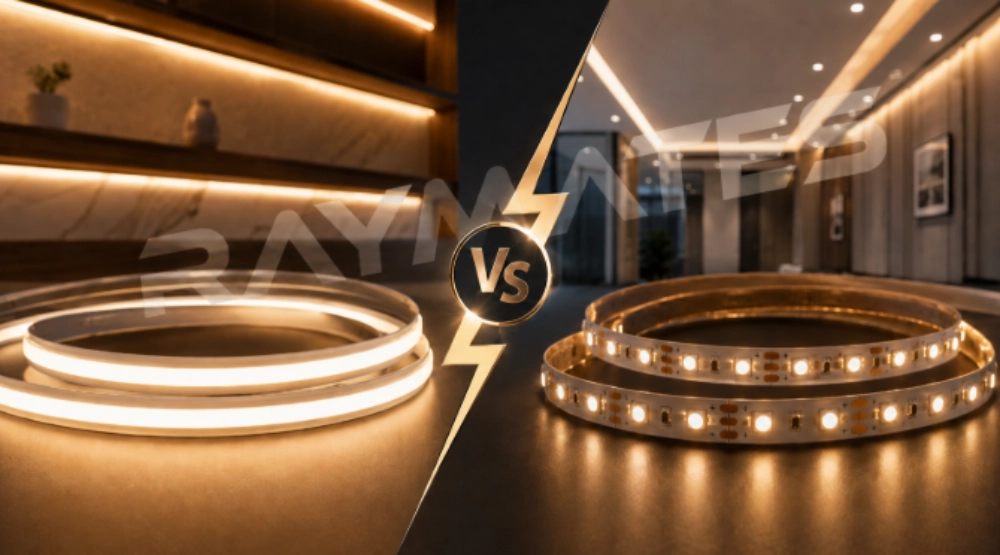
For commercial lighting, a COB LED Strip usually has an advantage when the project needs a smooth linear glow, limited visible hotspots, shallow aluminum profiles, and clean close-range viewing. SMD strips still have an important role when color-changing effects, established package formats, special routing requirements, or specific control functions matter more.
Raymates manufactures LED strip solutions for commercial, architectural, hospitality, retail, and decorative projects. Its product range covers COB strips as well as conventional LED strip configurations, with voltage, power, board width, control, and installation options that can be matched to different project conditions. For buyers, the useful question is therefore not whether one technology is universally better. The better question is which construction gives the required light effect with fewer installation compromises.
What Is the Practical Difference Between COB and SMD LED Strips?
The main difference starts with LED packaging. That construction affects what the finished light line looks like, how much diffusion space is needed, and which applications each strip handles more naturally.
COB Integrates Bare Chips Into a Continuous Light Source
COB uses closely arranged bare LED chips on a flexible substrate, followed by a continuous phosphor or encapsulation layer. This construction reduces the visual separation between individual emitting points.
The result is useful for retail display lighting, hotel coves, shelves, counters, cabinets, and architectural lines where the strip is installed close to the diffuser or where reflected light is visible on polished surfaces. High CRI, light uniformity, thermal management, and color consistency are more useful buying criteria here than simply counting LEDs per meter.
SMD Uses Individually Packaged Surface-Mount LEDs
SMD strips use individually packaged surface-mount LEDs such as 2835, 3528, 4040, or 5050 packages. The distance between those packages can create visible points if the strip is installed in a shallow profile.
This does not make SMD unsuitable for commercial work. Deeper channels, suitable diffuser spacing, indirect installation, or projects where the strip itself is hidden can reduce the importance of dot visibility. SMD also remains practical for RGB lighting, signage, entertainment spaces, and installations built around established controllers.
Package Architecture Changes the Final Light Effect
The comparison is easier when buyers look at the finished installation rather than the LED package alone.
| Project Priority | COB | SMD |
| Smooth continuous light | Strong advantage | Depends more on LED spacing and diffuser depth |
| Shallow aluminum profiles | Easier to achieve a clean light line | Hotspots require closer attention |
| RGB and dynamic effects | Available in selected configurations | Broadly used for color-control projects |
| Hidden indirect lighting | Suitable | Often practical |
| Close-view retail displays | Strong fit | Requires careful optical design |
| Existing SMD-based fixtures | May require redesign | Easier to retain existing configuration |
The right specification should include the profile, diffuser, viewing distance, driver, controls, and installation environment.
When Does COB Beat SMD in Commercial Lighting?
For a commercial project, a cob led strip becomes especially useful when the visual quality of the light line is part of the design. This is common in hotels, retail fixtures, furniture lighting, cabinets, reception areas, display cases, and architectural details.
Premium Linear Lighting With No Visible Hotspots
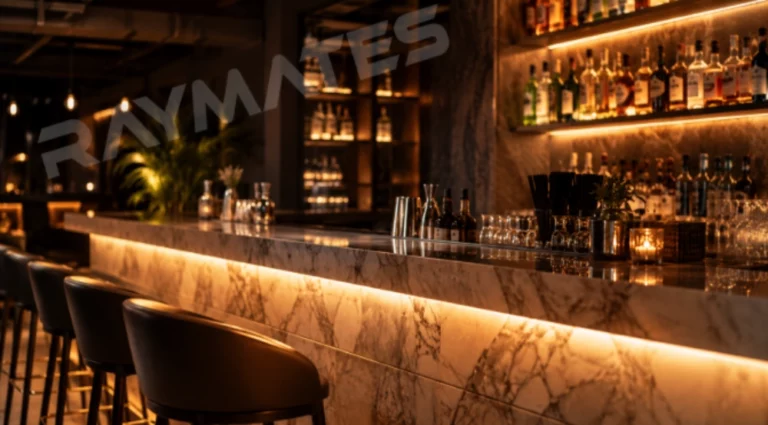
Visible light dots can make a carefully designed retail shelf or hotel cove look uneven. They become more noticeable when the diffuser sits close to the strip or when light reflects from glass, metal, stone, or other smooth materials.
Raymates’ Hot Selling COB Strip is suited to this type of linear installation. Rather than relying on a deep channel to blend separate LED points, its COB construction produces a more continuous emitting surface.
For buyers searching for a High Lumen COB LED Strip for Indoor Lighting, lumen output should still be considered together with CRI, power density, heat dissipation, and profile dimensions. More output is not automatically more useful if the installation traps heat or creates excessive brightness on a display surface.
Shallow Profiles, Retail Displays, and Hospitality Interiors
Shallow profiles leave less distance for a diffuser to mix light from separate LEDs. That is one reason cob led strip products are frequently specified for visible linear features.
A High Efficiency COB Strip for Retail Display can work well for shelves, display cabinets, wall recesses, reception desks, furniture edges, and under cabinet strip lighting where smooth illumination matters at close viewing distance.
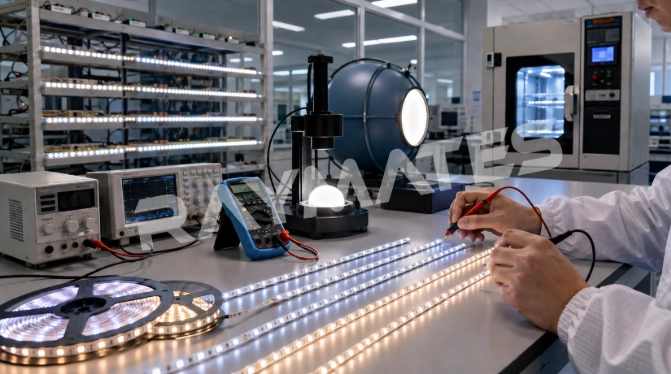
Color rendering also deserves attention. A strip used around clothing, cosmetics, decorative finishes, or food displays should reproduce colors consistently rather than simply look bright. For procurement, CRI and color consistency should be checked alongside wattage and color temperature.
Long Continuous Runs With Fewer Visual Interruptions
Commercial corridors, coves, shelving systems, and architectural outlines often require longer runs than small furniture installations. Every additional feed point, connector, and joint increases installation work and creates another location that must be checked during commissioning.
Raymates’ Super Long COB Strip is intended for projects where longer continuous runs are a major design requirement. Even with a long-run product, electrical planning still matters. Cable size, voltage, driver load, connection layout, and actual installation length must be calculated before ordering.
Buyers searching for wholesale led strip lights for large projects should ask for a complete run-length and power plan rather than specifying only the number of meters required.
When Is SMD Still the Better Choice?
COB is not automatically the right answer for every installation. Some commercial projects place more value on color effects, compatibility, routing flexibility, or an existing SMD-based fixture design.
Dynamic Color and Addressable Effects
Bars, entertainment venues, event spaces, branded displays, signage, and interactive interiors may need changing colors more than a continuous white light line.
Raymates’ Colorful LED Strip uses SMD package options and supports configurations such as RGB, RGBW, RGBCW, and addressable lighting. This makes it relevant where a controller must create changing colors, zones, sequences, or dynamic effects.
In such applications, choosing SMD does not mean accepting a lower-grade solution. It means the project gives more weight to control capability than to completely eliminating individual emitting points.
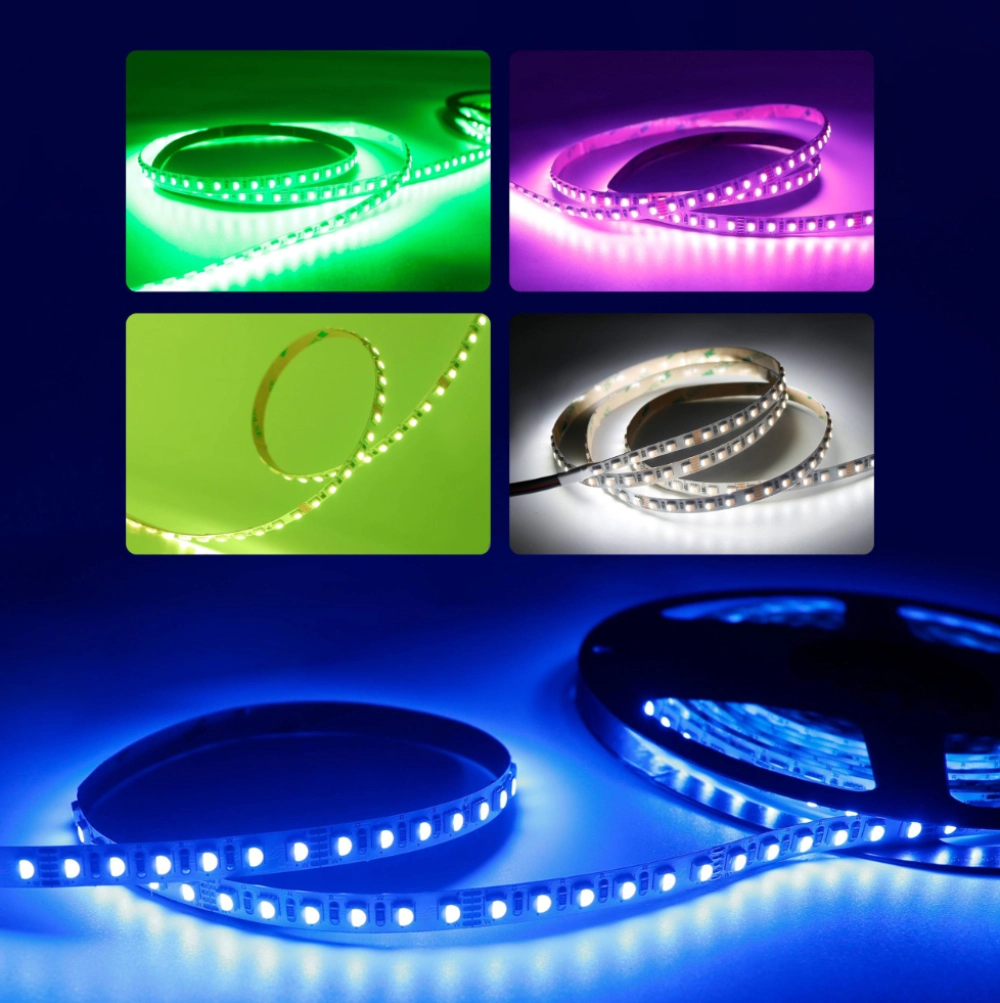
Conventional SMD Formats Offer Flexible Project Configurations
Many commercial fixtures and control systems have already been designed around established SMD package formats. Replacing the technology may require changes to PCB width, connectors, driver loading, profiles, or optical components.
For replacement work and repeat production, keeping a proven SMD configuration can reduce unnecessary redesign. This is particularly relevant for an led strip manufacturer supplying OEM or ODM projects where dimensions, cut points, connector locations, and electrical specifications must fit an existing fixture.
Price comparisons should also include profiles, diffusers, drivers, controllers, connectors, installation labor, and future servicing. Comparing strip price alone gives an incomplete picture of maintenance cost.
Special Bending Requirements Can Change the Decision
Some installations are limited more by mechanical routing than by light uniformity. Curved furniture, display structures, narrow channels, letters, and irregular interior details may require the PCB to follow a defined route without excessive mechanical stress.
The LED Strip S2 Series can be evaluated for these mechanically constrained layouts. Buyers should confirm bending direction, board width, cutting positions, connection method, and the available space before production.
For these projects, a strip that fits the physical path safely may be more useful than choosing a technology only because it produces a smoother light line.
How Should Commercial Buyers Compare COB and SMD Before Ordering?
Specification errors normally happen when one parameter is treated in isolation. A cob led strip or SMD strip should be selected as part of a complete electrical, thermal, optical, and installation system.
Match Light Quality to Viewing Distance and Surface Finish
First determine whether the light source will be visible directly, through a diffuser, or only as reflected light.
Retail shelves, glass cabinets, hotel millwork, reception counters, and glossy decorative surfaces expose uneven illumination more easily. COB is therefore easier to specify in many close-view installations. Hidden ceiling coves and deep channels give SMD more space to blend.
The decision should be based on a sample installed in the actual profile whenever appearance is critical.
Check Voltage, Power, Board Width, and Heat Dissipation
Raymates supports different low-voltage configurations and board widths for different installation spaces. These parameters affect driver selection, wiring, profile size, and thermal behavior.
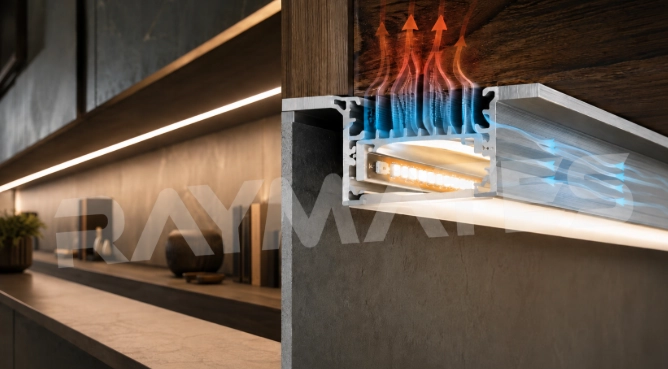
A cob led strip installed inside a narrow enclosed channel can still experience heat buildup. Higher power density without enough heat transfer raises operating temperature at the PCB and soldering areas. Aluminum profiles can provide mechanical protection and a larger heat-spreading surface, but the profile must have enough contact with the strip and enough room to release heat.
This matters for industrial led strip lights, retail fixtures running for long hours, and enclosed cabinet systems.
Plan Drivers, Profiles, Connectors, and Environmental Protection
A commercial strip system may also require a power supply, controller, connectors, extension cables, mounting clips, aluminum channels, and end caps. Buyers should confirm these components before bulk production rather than treat them as site accessories to solve later.
Outdoor or humid projects add another layer. If a buyer is screening a waterproof LED strip manufacturer, the discussion should cover the strip body, cut ends, cable entries, connectors, and site sealing method. An appropriate waterproof construction can still fail if the installer cuts the strip and leaves the new termination unsealed.
Which Raymates LED Strip Fits Your Commercial Project?
Raymates has both COB and conventional LED strip options, so buyers can match the product to the project rather than force one technology into every application.
Hot Selling and Super Long COB Strips for Uniform Commercial Runs
Choose Hot Selling COB Strip where visible uniformity, shallow profiles, retail presentation, hotel lighting, cabinetry, or architectural linear lighting are the main concerns.
Choose Super Long COB Strip when the project includes extended coves, corridors, long shelves, or continuous architectural runs and reducing intermediate connections is important.
In both cases, the cob led strip should still be specified together with the driver, total run length, profile, color temperature, installation environment, and maintenance access.
Colorful LED Strip and S2 Series for SMD Applications
Colorful LED Strip fits commercial decoration, entertainment venues, branded displays, and projects where RGB or programmable effects drive the design.
The S2 Series is more relevant where installation geometry needs careful checking and the strip must fit an existing or mechanically restricted structure.
For buyers sourcing wholesale led strip lights, keeping both COB and SMD options available is often more practical than standardizing every project on one construction.
OEM/ODM Service, Technical Support, and Contact
Project specifications often involve more than selecting a catalog model. Raymates can match voltage, power, board width, control, accessories, and installation requirements to OEM/ODM needs. Technical communication can also cover project drawings and installation details before production, reducing changes after the strips arrive on site.
The practical rule is simple: use COB LED Strip where continuous appearance and close-view light quality carry the most weight; retain SMD where control functions, existing fixture design, or mechanical requirements make it more suitable.
If your project includes shallow profiles, long runs, difficult routing, waterproofing, or uncertainty about driver and controller matching, send the run length, installation drawing, required light color, profile dimensions, and operating environment through the Raymates contact page. Those details make it easier to compare suitable strip structures before samples or bulk quantities are confirmed.
FAQ
Is COB LED Strip Better Than SMD for Commercial Lighting?
It is better for many projects where smooth linear illumination, limited visible hotspots, shallow profiles, and close-range viewing are priorities. SMD can be more suitable where dynamic RGB control, an established fixture configuration, or specific mechanical requirements have greater importance.
Can COB Strips Be Used for Retail and Hotel Lighting?
Yes. COB strips fit retail shelves, display cabinets, hotel coves, reception areas, cabinetry, and decorative linear features because the closely arranged light source helps create a continuous appearance. Buyers should still check CRI, color temperature, power, profile size, and operating temperature for the actual installation.
Should I Choose COB or SMD for Long Commercial LED Strip Runs?
Start with the electrical layout rather than the package type. Check total length, voltage, cable size, driver loading, feed points, connectors, and acceptable brightness variation. Long-run COB products can reduce connection points in suitable projects, while SMD may remain appropriate where the existing fixture or control system is already designed around it.