Planning a quality lighting setup often means focusing on even, spotless illumination. For this reason, the 480 LED Strip serves as a common choice for fine linear lights. Yet prior to fitting long sections of dense tape, one must figure out the energy needs. Figuring out power use goes beyond picking a connector. It involves protecting the durability of the setup. Lighting experts or large buyers benefit from accurate electrical planning. This avoids excess warmth and unsteady glow.
For those seeking a reliable source in effective lighting, consider Raymates. Located in Beijing, the firm stands out as more than a basic plant. It specializes in business-to-business materials and practical production for worldwide buyers. The emphasis falls on areas needing exact work, like factory tools and building lights. Partnering with this group offers solid items plus a focus on design that aligns with key standards and output goals. Every request receives careful attention, delivering the clear details needed to thrive in a tough field.
How Much Is the 480 LED Per Meter Strip Power Consumption?
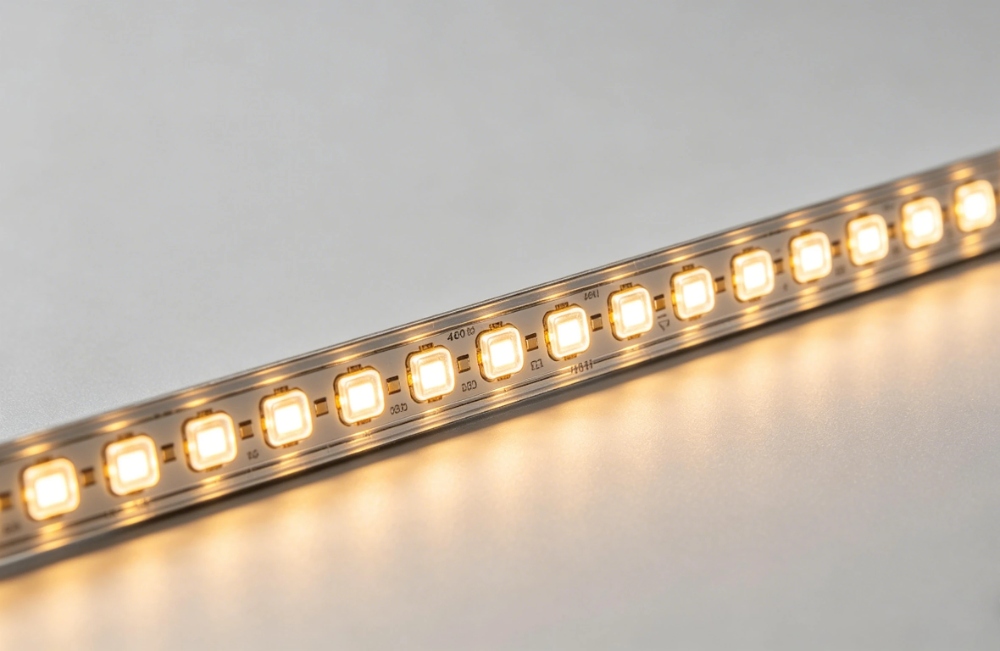
Understanding the full energy pull of a dense tape marks the initial move for a steady setup. The 480 led per meter strip power consumption reflects hundreds of small lights fitted on one board. These lights sit near each other, often in a Chip on Board (COB) setup. Thus, they use more energy per length than basic sparse tapes. Typically, a solid item in this group takes 10 to 15 watts per meter.
Exact use varies with the phosphor layer’s standard and the copper paths’ performance. A 5-meter roll might total 75W. Such density removes the dotted pattern seen in past LED designs. However, it calls for a strong base to maintain cool and steady brightness in the lights.
High Density 480 LED Per Meter Strip Wattage Variance
Various makers report differing figures for matching light numbers. The high density 480 led per meter strip wattage variance stems from the “drive current” set by board resistors. Certain tapes aim for peak shine, raising power to 15W per meter. Others focus on saving energy at 8W or 10W per meter.
Reviewing these details requires noting light output per watt. Greater power does not guarantee superior glow. It may simply produce extra warmth. In business settings, balance matters. The power level should deliver strong light without large cooling parts.
COB 480 LED Per Meter Strip Energy Efficiency Benchmarks
To secure a prime product, seek cob 480 led per meter strip energy efficiency over 100 lumens per watt. In business circles, such performance cuts costs long-term. This holds true in work areas with lights on for over 12 hours daily. Strong COB tapes employ better covering that lets more light out. At the same time, they create less unused warmth. This feature proves vital in closed spots like shelves or wall indents with poor air flow.
Comparison Between 12V and 24V Power Loads
A key choice involves selecting 12V or 24V. While 12V suits vehicle or simple home tasks, 24V fits expert dense lighting needs. A 24V arrangement handles half the flow of a 12V one for equal power. Lower flow permits slimmer cables. It also cuts “voltage drop,” the fading effect at a run’s end.
| Specification (Per Meter) | 12V System (Standard) | 24V System (Professional) |
|---|---|---|
| Typical Wattage | 10W – 12W | 10W – 15W |
| Current (Amperage) | 0.83A – 1.0A | 0.41A – 0.62A |
| Max Run Length | 5 Meters | 10+ Meters |
| Voltage Drop Risk | High | Low |
Why Use a 24V 480 LED Strip Power Supply Calculator?
Guessing harms electrical work. A 24v 480 led strip power supply calculator guarantees proper energy supply. Many err by matching a 100W unit to a 100W need. Such pairing leads to breakdowns. Stick to the “80% Rule”: keep loads under 80% of a unit’s limit. For an 80W tape, select at least a 100W source. This spare 20% shields parts from spikes. It also stops overheating, boosting the unit’s life.
Determination of 480 LED Strip Light Amperage Per Meter
Finding the full load proves straightforward with the 480 led strip light amperage per meter known. Apply the equation: Amperage (I) = Wattage (P) / Voltage (V).
- A 12W per meter tape at 24V draws 0.5A per meter.
- A 10-meter length then totals 5.0A.
This figure guides cable thickness selection. High flow demands wider lines to avoid warmth buildup and fire risks.
Calculation of the Twenty Percent Safety Margin
That 20% buffer acts as protection. In factory settings with varying grids, it stops light flickers. For big efforts with several 480 LED Strip rolls, add all power figures and times by 1.2. Such steps make the system sturdy and dependable for ongoing tasks.
Which Models Best Manage the 480 LED Strip Output?
Dense tapes differ in build. Based on the site, be it a small edge or wide room, a certain style fits best. Dense lights create a smooth “neon” effect. Yet warmth control must excel to cope with the 480 LED Strip energy density.
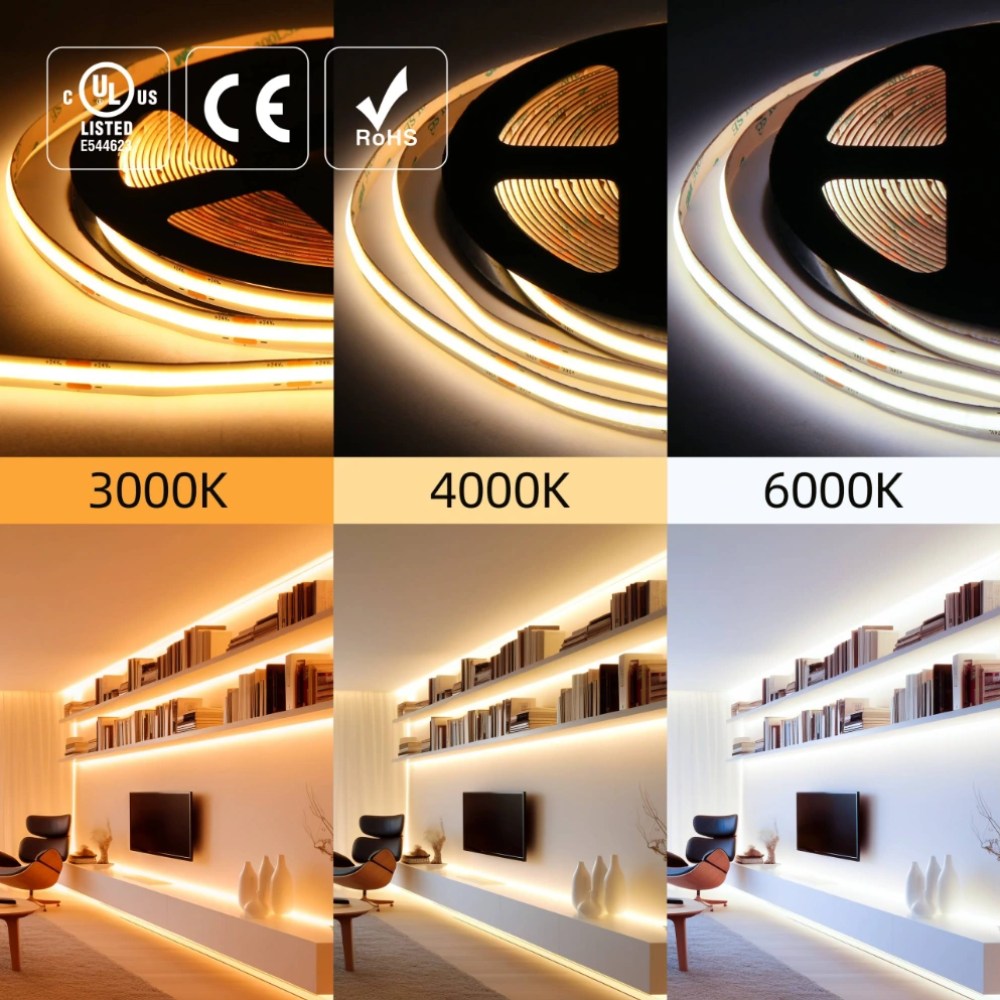
Mini Size COB Strip for Extremely Narrow Spaces
Slim metal channels or detailed fixtures limit room. The mini size cob strip addresses this by narrowing the board while keeping light numbers. It holds the high density 480 led per meter strip wattage in spots as tight as 3mm or 5mm. This suits backlights or high-end shop racks where the source stays hidden.
Hot Selling COB Strip for Balanced Brightness and Performance
Standard building tasks benefit from the hot selling cob strip. This option delivers steady cob 480 led per meter strip energy efficiency with an 8mm or 10mm width. It pairs well with usual 24V units, yielding over 1000 lumens per meter. Sellers favor it for fitting most trade uses reliably.
Super Long COB Strip for Consistent Light Without Current Drop
Big areas like hall paths or work outlines need lengths beyond 5 meters. Regular tapes lose shine at the far end from opposition. The super long cob strip applies steady flow chips or wider copper lines for 10, 15, or 20 meter spans on one feed. It handles the 480 led per meter strip power consumption smartly. Thus, the start matches the end in brightness.
| Product Type | Best For | Typical Power Draw |
|---|---|---|
| Mini Size COB | Narrow Grooves / Furniture | 5W – 8W / m |
| Hot Selling COB | General Interior / Coves | 10W – 12W / m |
| Super Long COB | Long Corridors / Perimeter | 8W – 10W / m |
Achieving Long Term Reliability with Professional Engineering
A dense light array depends on warmth release. The 480 LED Strip produces focused heat. Mount it on metal, ideally aluminum channels. The metal pulls heat from the parts. Cool parts keep true colors (CRI) and avoid early fading.
Board standard also counts. Expert tapes feature 2oz or 3oz copper. Such thickness moves the 24v 480 led strip power supply current smoothly. Less energy turns to warmth. More becomes clear, appealing light.
Accessing Expert Support for Your Lighting Project
Miscalculating the wattage for a high-density 480 LED Strip often causes permanent voltage drop or overheating that risks your project’s reputation. We can provide project-specific IES files and customized wiring diagrams so that you can secure your system’s longevity with engineering-grade precision. By sharing your total run length and installation environment when you contact our team, you will receive targeted technical parameter data and professional installation guidance tailored to your specific layout. This personalized support ensures your high-performance lighting setup meets every professional benchmark from day one.
FAQ
Q: Can I use a 12V power supply for a 24V 480 LED Strip?
A: No. A 24V tape fails to glow right (or at all) on 12V. Likewise, a 12V tape on 24V burns out fast. Match voltage between tape and source always.
Q: How do I know if my 480 LED Strip is too hot?
A: Run the tape 30 minutes, then feel the metal back. Warmth should feel mild, not burning. If touch hurts, consider less power or bigger cooling metal.
Q: Is it better to have one large power supply or several small ones?
A: For far reaches, multiple small units near tapes work well. Shorter low-voltage lines cut fading. Light stays even across the whole area.