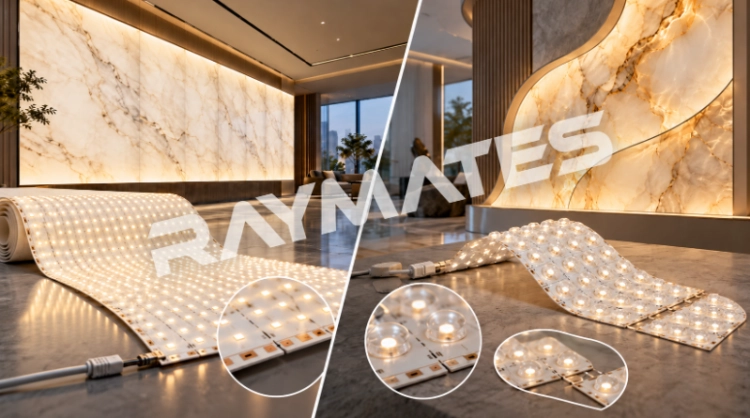
Before comparing sheet prices, lay the lighting drawing over the reception wall or marble counter it belongs to. Matrix LED Sheet and Lensed LED Sheet may both light the surface, but depth, shape and cable access can rule one out. A bright sample in open air does not settle those installation questions.
Raymates‘ flexible sheets are used in commercial and architectural lighting, from retail displays to backlit stone and light boxes. The featured Matrix and Lensed formats give a buyer two different ways to cover and trim that area.
What Are Matrix and Lensed LED Sheets?
A grid of LEDs is only the first visual difference. I would also compare the sheet’s size, its optics and where the installer can reach the wiring after the panel is closed.
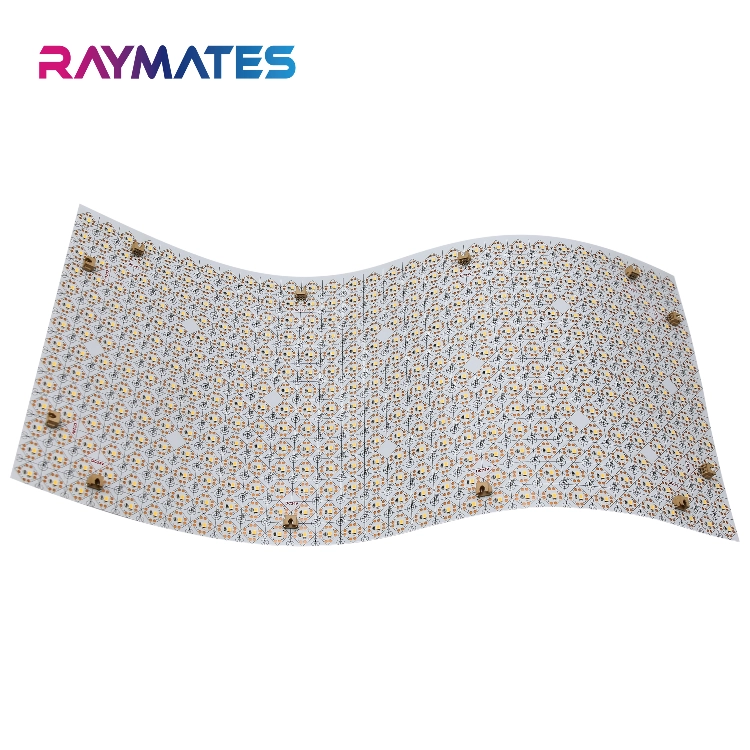
These are Raymates product formats, not opposite LED technologies. The Super long Matrix LED Sheet supplies broad coverage from a roll; the featured Lensed LED Sheet is smaller and uses lenses to spread light around detailed cuts. A matrix can have lenses too. I would read the construction and model specification before assuming every Matrix LED Sheet is lens-free.
Matrix LED Sheets for Continuous Backlighting
Raymates lists its Super long Matrix LED Sheet as a continuous 10-meter roll, 240 mm wide. Across a long reception wall or advertising panel, that can mean fewer sheet joints and less connection work behind the surface. The benefit matters only if the roll can be placed and powered as the drawing requires.
The sheet is flexible and can be cut, but not anywhere an installer happens to need an edge. Mark the permitted cut positions on the layout before ordering, or the trimming plan may run through a circuit.
Lensed LED Sheets for Controlled Light Distribution
On Raymates’ Lensed LED Sheet, an optical lens sits over each LED to change its spread. The featured piece is 500 × 250 mm and offers a one-LED cutting option. That combination is worth examining around smaller features or cutouts.
The lens can sometimes be of assistance when bright points might otherwise bleed through a thin panel, but it must always be judged under the chosen diffuser. With an led backlight sheet with optical lens, both the gap to the finished surface and also, of course the geometry of the lens affect what a visitor sees. The design gap from sheet to the finished surface and geometry of lens both make themselves clear in a sheet with optical lens for LED backlight reason.
What Are the Key Performance Differences Between Matrix and Lensed LED Sheets?
At a sample review I query where hotspots are visible, how much trimming the board requires and also map out patch cord positions. Normally the practical difference between both layouts of LED Sheet will be reveal with those three answers. The answers to those three questions will typically reveal the difference in functionality between the two LED Sheet configurations.
Light Distribution and Hotspot Control
The lens changes the area lit by each emitter. Final evenness still depends on spacing between LEDs, cavity depth and the stone or diffuser placed over them.
A thin cavity can show the individual points. Stone adds another complication because one patch may transmit differently from the next. Even with lenses, a diffuser set too close may reveal hotspots that the bare sheet did not warn us about.
Put the actual stone or display facing over a sample of the LED backlight sheet with optical lens. Set the planned gap and look for light and dark patches across the whole surface. A white card is useful for setup, but it cannot approve a veined slab.
Surface Coverage and Cutting Flexibility
I put the cut diagram beside the installation drawing. The number of joins and the offcut at each edge become visible immediately.
A long Matrix run may mean fewer pieces. The Lensed LED Sheet may sit better around shaped cutouts. Neither helps if the permitted cutting marks land in the wrong place for the finished edge.
For a custom LED sheet layout, I measure the part that must be illuminated, excluding frame, support and unlit border from the area calculation.
| Selection Factor | Matrix LED Sheet | Lensed LED Sheet |
| Primary Design Advantage | Long, continuous coverage | Lens-controlled light distribution |
| Featured Product Format | 10 m roll, 240 mm wide | 500 × 250 mm sheet |
| Cutting Approach | Cuttable at permitted positions | One-LED cutting option |
| Wiring Consideration | Fewer joints across long runs | Multiple sections may require more connections |
| Common Project Fit | Large feature walls and commercial light boxes | Detailed shapes and projects requiring optical control |
Installation Flexibility and Connection Requirements
A bendable LED sheet can wrap a gentle curve. At a tight corner I would change the layout instead of creasing the circuit.
Now sketch the exit for canonical cable with temperature resistant paper before adhesive process. The supply must remain serviceable. Prepare the substrate and check for adhesive contact on a curved wall or counter; uneven pressure can allow the sheet to lift. Locate your substrate on a curved wall or counter and test the adhesive contact; tile pressure may cause sheet lifting.
For several joined sections, confirm polarity, cable capacity and connector fit on the bench before powering the completed panel.
Which LED Sheet Is Better for Different Backlighting Applications?
The facing material, depth, dimensions and shape determine the shortlist. A broad flat wall calls for a different coverage plan from a narrow, translucent countertop edge.
Large Light Boxes and Commercial Feature Walls
For an extended feature wall, I would start by laying out the Super long Matrix LED Sheet. Its continuous roll may reduce joints and simplify the wiring behind a large lit area.
If a light box is shallow enough that LED points show, I would mock up the Lensed LED Sheet and inspect what its optics do behind the chosen diffuser.
An uncovered LED Sheet is only a component test. The decision on LED sheet lights for backlighting should come from the assembled panel at its real viewing distance.
Marble, Onyx, and Backlit Countertops
Natural veining and thickness variation make translucent stone a hard test material. A support bar underneath may leave a shadow even when the LEDs themselves are evenly spaced.
Before laying out countertop LED sheets, mark every stone seam, bracket and other support that could interrupt the light. A drawing without those parts can lead to a misleadingly smooth sample.
A long marble bar front might use a continuous Matrix roll. Around detailed openings, several smaller Lensed sections may waste less material. I would sketch both before treating either as the default.
Raymates has placed flexible LED sheets under a marble bar counter and trimmed them around corners to follow its design. That is a useful installation example, though another stone surface still needs its own layout and light test.
For a broad marble or onyx panel, light a piece of the actual stone while feed locations and sheet spacing can still be changed.
Curved Surfaces and Custom-Shaped Displays
A retail plinth can taper at one end; a rounded bar can leave a narrow corner. Those are the places a full rectangular sheet may not reach cleanly.
The marked cuts on the Lensed LED Sheet may help fit a custom LED sheet layout into those spaces. Put each proposed cut on the drawing before the installer starts trimming.
The bendable LED sheet needs a clean mounting surface and a cable route that does not pinch at the corner. For countertop LED sheets or a cabinet, I would build that corner first and inspect both the connector and lit facing.
What Should B2B Buyers Check Before Ordering LED Sheets?
A low sheet price can be lost in extra joints, wiring and later access work. I would review the panel as an installed assembly.
Voltage, driver, cut locations, adhesive surface and a route for service all belong on the bulk-order drawing.
Voltage, Power, and Driver Compatibility
Start with the exact Raymates model on the quotation before choosing its power supply.
The featured Lensed LED Sheet is DC24V and rated at 30W per sheet. Do not carry those figures across to the Matrix model without its own specification.
Count the connected sheets to work out load and driver capacity, then account for loss along extended cable runs.
On RGBW work, check the controller as well as the driver. Enough wattage cannot compensate for the wrong output voltage.
Cutting Plans, Installation Labor, and Material Waste
Cut through a circuit and the offcut may be unusable. Follow the product’s marked positions, even where the edge then needs another piece.
I would send a cut drawing before ordering, with feed points, connector locations, offcuts and clearance around the finished panel shown on it.
A Matrix roll may save join work on a large surface; on a shaped panel, smaller Lensed pieces may leave less waste. Price both with labor and offcuts included.
For the method behind those cuts, see How to Cut and Customize Your LED Sheets for Perfect Lighting Solutions.
Durability, Quality Control, and Long-Term Costs
The cheaper sheet is not always the cheaper installation to maintain.
Once stone or glass is fixed in place, a failed section may be hard to reach. Plan a replacement route. For repeat orders, set the permitted difference in white tone and brightness between batches.
Protect flexible circuits from sharp folds in transit and store them dry, away from moisture that can oxidize contacts.
Those simple handling choices can spare later service calls on commercial LED sheet lights for backlighting.
How Can Raymates Help You Choose the Right LED Sheet?
For a useful Raymates recommendation, send the surface shape, facing material and depth behind it. A sales drawing of the front alone leaves too much out.
When we compare these LED Sheet formats, a material sample and an installation section often answer questions the product photos leave open.
Application-Based LED Sheet Recommendations
For a long, mostly continuous surface, put the Matrix roll on the first layout if fewer joints are valuable.
For a detailed edge or a need to spread each LED’s light, put the Lensed version beside it in the mock-up.
Shallow box? Measure the diffuser gap. Stone? Light the actual piece. Irregular retail panel? Show the cuts and each electrical connection before ordering.
OEM/ODM Customization and Technical Support
Raymates can discuss OEM/ODM requirements from a project drawing and installation plan.
Send the dimensions and cutouts, the requested color, likely quantity and proposed driver locations.
For a custom LED sheet sample, settle the cutting pattern, electrical interface and installation clearances before calling it approved.
Explore LED Sheet Solutions and Contact Raymates
The Raymates LED Sheet collection is a starting point for putting both formats on the same shortlist.
The Super long Matrix LED Sheet brings length and broad coverage. The Lensed LED Sheet brings optical control and smaller cutting choices. I would compare them on the same panel drawing.
Sheet size cannot decide the order by itself. The lit surface, mounting method and electrical plan have to work together.
Send Raymates the panel drawing, backlit material, cavity depth, target color and likely order volume. Note hotspots, bends or wiring that cannot be reached once the panel is closed.
FAQ
Which Is Better for a Shallow Light Box: Matrix LED Sheet or Lensed LED Sheet?
Try the Lensed LED Sheet first if visible points are the concern. Its optics may help, but a lens cannot promise an even shallow box. Mock up the actual diffuser at the intended gap and compare both sheets there.
Which LED Sheet Works Better for Backlit Marble Countertops?
On a long, fairly regular countertop face, the Matrix LED Sheet roll is worth laying out because it may avoid several connections. At a narrow edge or irregular cutout, small Lensed LED Sheet sections may make the layout easier to install.
The actual stone, its thickness and translucency, the panel shape and the available gap should settle the final choice.
Can Lensed LED Sheets Be Cut to Fit an Irregular Display?
Yes. The featured Raymates Lensed LED Sheet has designated cuts, including a one-LED cutting option.
Follow those marks so the circuit survives, and show how every piece left after cutting will receive power.