A long lighting run may look bright near the driver but become dimmer or less color-consistent at the far end. This is when power injection becomes useful for LED Strip Lights. An extra feed point shortens the distance that current must travel through the flexible circuit and supply wires. It does not simply add wattage; it changes how power reaches the load.
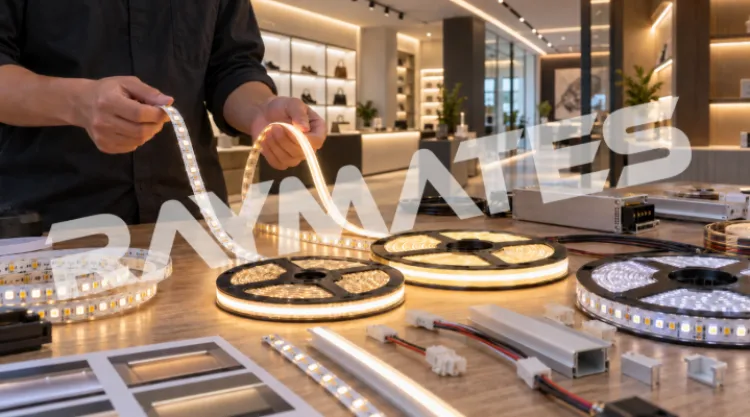
Raymates manufactures flexible lighting for residential, commercial, and architectural projects. Its range covers low-voltage products from 3V to 48V, high-voltage products from 110V to 230V, and board widths from 3 mm to 30 mm. Voltage, power, length, and packaging can also be adjusted. Raymates can coordinate strips, drivers, controllers, connectors, extension cables, splitters, profiles, drawings, and installation guidance as one system. The company has export experience in more than 30 countries.
Why Do LED Strip Lights Need Power Injection?
The problem usually comes from the complete electrical path. PCB conductors, cables, connectors, joints, and the controller all add resistance. A driver may have enough capacity while the far end still receives less voltage.
Voltage Loss Along the Flexible PCB
As current travels farther, LED strip voltage drop becomes more visible. High load, long supply cables, narrow conductors, repeated connectors, and multiple branches can increase it.
There is no reliable rule that every strip needs another feed after one fixed distance. Check voltage, wattage per meter, total length, PCB design, wire route, and connection method together.
Visible Signs at the Far End
Common signs include a dim far end, uneven white light, color shift, or flicker at full output. Some led strip lights look normal at reduced brightness but fail when all channels operate.
| Symptom | First Check |
|---|---|
| Far end is dimmer | Compare voltage at the beginning and end |
| Color changes | Test each channel at full output |
| Entire run flickers | Check driver capacity and connections |
| One section fails | Inspect polarity, cut points, and joints |
Projects Most Likely to Need Additional Feeds
Long display cases, hotel coves, counters, shelving, and architectural lines deserve early review. Remote drivers, hidden cable paths, and multiple branches add risk.
The Hot Selling COB Strip suits standard linear layouts requiring a continuous COB appearance. Match it with the run length, feed positions, driver location, and maintenance access.
When Should You Add Power Injection?
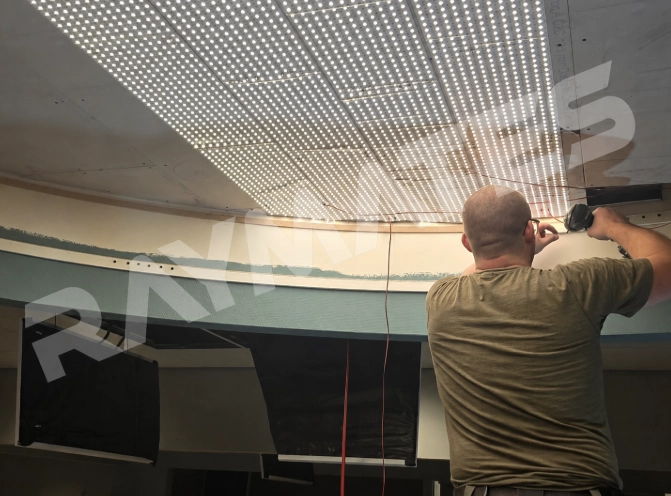
Plan it before the strip is fixed inside a ceiling, cabinet, wall recess, or stone feature. Power injection for LED strips is easier to manage when cable routes and service points are included in the first drawing.
Calculate the Electrical Load Before Installation
Record the operating voltage, wattage per meter, total length, and number of branches. Then calculate the expected load for each circuit. The LED strip power supply must support that load, but a larger driver alone cannot remove resistance from a long strip or cable.
Check the controller, connectors, splitters, and wire as well. Any one of them can limit the system.
Check the Installation Layout
Mark the driver, controller, strip sections, injection points, cable lengths, and access openings. A straight run may suit an end or center feed; multi-shelf displays often work better as parallel branches.
Check future access. A feed point behind sealed cabinetry or stone may work electrically but complicate maintenance.
Test the Farthest Point Under Full Load
Bench-test the planned length before mounting. Use the highest required brightness and color mode, then compare the beginning, middle, and far end.
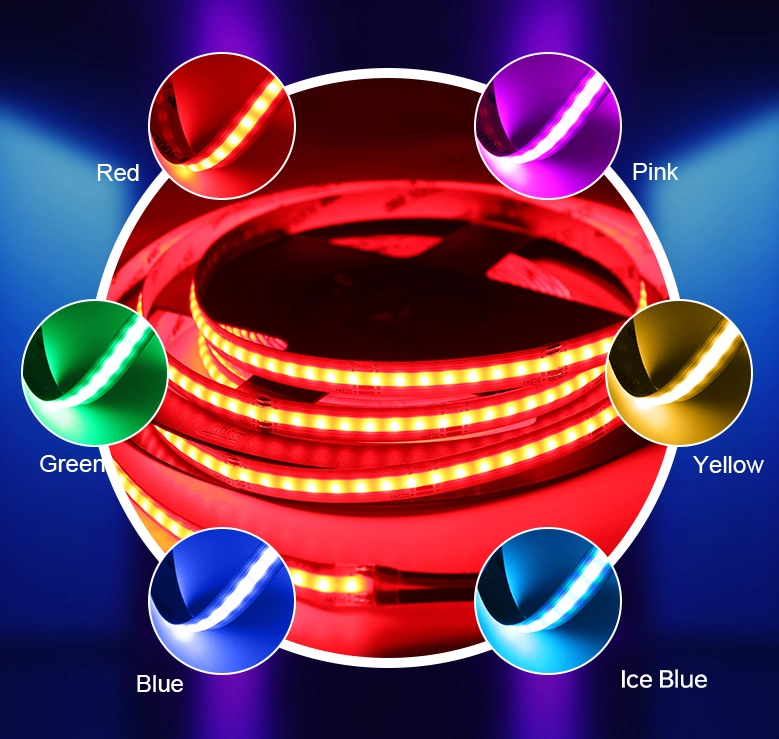
This is especially relevant to the Colorful COB Strip. A color-controlled project must maintain brightness and channel consistency. Raymates’ project records include RGB flexible strips used across a bowling-alley lighting installation, showing why complete-layout testing matters more than checking one short reel.
How Should You Add Power Injection Safely?
Adding a feed creates another current path, so position, polarity, cable size, and power arrangement must be planned together.
Choose the Injection Position
End injection can support the far end of a straight run. Center injection divides the current path in two directions. Multiple parallel feeds suit shelves, branches, and zones that return to a common distribution point.
For long LED strip runs, choose positions from calculated load and measured voltage rather than appearance alone.
Keep Voltage and Polarity Consistent
Every branch must match the strip voltage. Positive and negative conductors must remain consistent. RGB or tunable systems also require the common conductor and every channel to be mapped correctly.
Do not connect separate driver outputs unless the design allows it. Reseal cut ends and cable entries on waterproof products.
Match Cables, Connectors, and Drivers
Choose cable size according to branch current, distance, route, and acceptable loss. Check connector capacity and soldered joints, not only the driver label. Heat-shrink tubing can protect joints, while end caps and silicone help rebuild environmental protection.
Aluminum profiles support mounting, physical protection, and heat transfer, but they do not correct an undersized conductor. Complete polarity, continuity, control, and full-load tests before fixing the LED Strip Lights.
Which LED Strip Design Can Reduce Power Injection Work?
Extra feeds are useful, but they are not always the simplest project answer. Product voltage, circuit design, control needs, cable access, and maintenance should be compared together.
Hot Selling COB Strip for Standard Linear Projects
The Hot Selling COB Strip suits cabinets, counters, furniture lines, and coves, while allowing the layout to be divided into manageable powered sections.
Use it where injection cables can be hidden and service points remain accessible. Final selection should still be based on voltage, power, run length, and installation structure.
Colorful COB Strip for Color-Controlled Projects
The Colorful COB Strip fits color-changing projects. Procurement should cover controller type, channel wiring, conductor count, dimming behavior, and full-load testing.
A short sample cannot confirm performance across the completed installation. Test each zone with the intended controller before approving the production quantity.
Super Long COB Strip for Extended Runs
Where many injection points would add too much cable or create inaccessible joints, the Super Long COB Strip may simplify the layout. It is a relevant COB LED strip for long runs where cleaner cable routing is a priority.
Long-run design still requires checks for voltage, load, cut arrangement, feed direction, control method, and environment. Compare complete system cost, not strip price alone.
How Can Raymates Support the Project from Layout to Delivery?
A B2B order is easier to control when site dimensions, section lengths, power locations, control needs, and destination details are confirmed before production.
Drawings, Wiring Plans, and Installation Guidance
Raymates can prepare installation diagrams, connection plans, project drawings, and cable-routing drawings based on the site layout. The team can help calculate required strip meterage, divide the project into powered sections, and mark driver, controller, and injection positions.
Engineering clients can also receive installation videos, connection instructions, and an LED strip wiring diagram. These materials reduce improvisation across multiple zones. The knowledge base records customized solutions, installation drawings, video tutorials, and online support.
Customized Specifications and One-Stop Coordination
Through its customized LED lighting service, Raymates can discuss strip length, voltage, power, color temperature, logo, packaging, and private-mold requirements. A project can also include drivers, controllers, connectors, cables, splitters, profiles, mounting parts, and sealing materials. Its official page states that drawings and solutions are available.
This one-stop structure helps reduce mismatched accessories and missing parts. Tax-inclusive delivery arrangements can also be discussed where the destination and order structure allow them.
Export Experience, Service, and Contact
Raymates supports OEM, ODM, and self-operated export orders. Buyers can provide dimensions, expected meterage, layout drawings, control preferences, installation conditions, and destination information for product and delivery review.
For uncertain injection spacing, hidden cable routes, or several zones, use the contact page to send the layout and required documents. A clear brief helps confirm the strip model, powered sections, accessories, wiring drawings, installation video, export packing, and available shipping arrangement.
A reliable plan for LED Strip Lights combines load calculation, full-length testing, accessible wiring, suitable products, and usable project documents. Decide before installation and keep every feed point traceable.
FAQ
Q: How do I know whether LED Strip Lights need power injection?
A: Check for reduced voltage, dimming, color shift, or flicker at the far end under full load. Also review total length, wattage, wire distance, connectors, and branch layout.
Q: Can a larger driver replace power injection?
A: A larger driver provides more total capacity, but it cannot remove resistance along the strip and cable. If the far-end voltage is low, a better feed layout may still be needed.
Q: Is center injection better than feeding both ends?
A: Neither method is always better. Center injection divides one run into two current paths, while feeding both ends may suit a straight strip with accessible ends. Choose from the load calculation, cable route, voltage test, and maintenance access.