A lighting layout can look correct on paper and still fail after installation. LED Strip Voltage Drop becomes more visible as strip length, cable distance, and connected load increase. Typical signs include dimmer ends, color shift, and warm connectors. The practical answer is to divide the system into calculated power zones and approve the cable route before finished surfaces are closed.
Raymates manufactures LED strip, COB strip, drivers, controllers, connectors, and accessories. For project orders, the company can review lighting length, site drawings, voltage, control method, waterproof needs, and cable restrictions, then provide installation diagrams, wiring solutions, route drawings, installation videos, product matching, and accessory lists. It also supports OEM and ODM work, exports to more than 30 countries, and can discuss tax-inclusive shipping where route conditions allow it.
Why Does LED Strip Voltage Drop Become a Bigger Risk in Commercial Projects?
Large projects combine long runs, concealed wiring, multiple branches, and limited access. One electrical error may affect an entire corridor or display wall.
Long Runs Increase Electrical Resistance
Longer PCB traces and supply cables lose more voltage before power reaches the far end. Wire gauge, current, connector quality, PCB design, and operating voltage all affect the result. Raymates offers low-voltage options from 3V to 48V, but the correct voltage must follow the actual layout.
Visible led strip voltage drop usually appears as reduced end brightness or uneven color.
End-to-End Wiring Concentrates Current in the First Section
Connecting several reels one after another sends downstream current through the first strip section and connector, which may cause heat and uneven output.
Parallel LED strip wiring is usually easier to control. Each branch returns to the power-distribution point instead of carrying the next branch’s load. Splitters, extension cables, and connectors can support this arrangement, provided their current ratings match the circuit.
Commercial Layouts Require Earlier Power Planning
Hotels, shops, corridors, bars, and display areas often hide electrical components behind finished surfaces. Adding power injection for LED strips later can mean reopening ceilings or cabinetry.
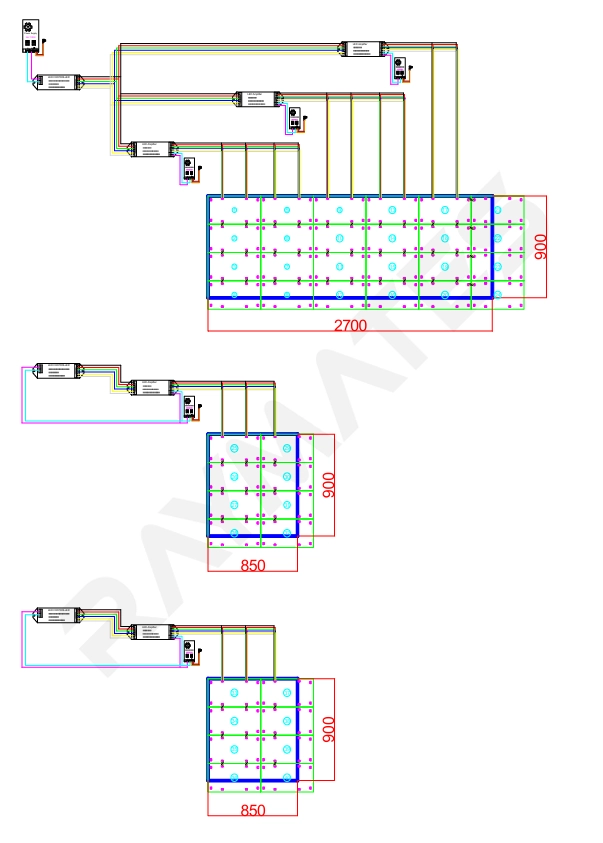
The drawing should show driver positions, cable routes, cutting points, branch lengths, control zones, and access panels. Early planning prevents led strip voltage drop from becoming an expensive site correction.
How Should You Plan the Wiring and Power Distribution Layout?
The design should follow the physical layout, not only total wattage. One long line needs a different plan from several short shelves.
Divide the Installation Into Parallel-Fed Power Zones
Divide the project by room, cabinet group, corridor section, or maintenance area. Each zone needs a known strip length, load, feed direction, and control requirement.
Use single-end feeding for short branches, dual-end or midpoint feeding for longer continuous sections, and parallel branches for repeated bays. This form of LED strip power distribution also allows one zone to be isolated without switching off the full system.
Place Drivers and Feed Points Near the Connected Loads
A nearby driver reduces cable distance. One central driver may suit grouped branches, while local drivers often work better across separate rooms or floors.
Power injection for LED strips should be based on strip wattage, run length, wire size, connector capacity, and service access. Random feed points may solve dimming but create inaccessible joints or unbalanced branches.
Confirm the Cable Route Before Ordering Components
The route drawing should identify strip lengths, cut points, drivers, controllers, branch junctions, feed directions, waterproof joints, and maintenance access.
Raymates can prepare installation diagrams, wiring solutions, route drawings, a bill of materials, and installation video guidance after checking how many meters of light are required and where cables can run.
Which LED Strip and Driver Specifications Fit Long Commercial Runs?
Product choice should reduce wiring difficulty. The strip and driver must suit the route, installation space, environment, and maintenance plan.
Super Long COB Strip Supports Extended Lighting Lines
The Super Long COB Strip suits corridors, continuous coves, commercial shelves, and architectural outlines where frequent feed points would increase labor and cable use.
Its role is to support long run LED strip lighting with fewer planned connections. Voltage, wattage, cable length, feed direction, waterproof construction, and ambient conditions still require checking. COB construction also creates a continuous line on reflective surfaces.
For projects affected by led strip voltage drop, the strip should be assessed together with the route drawing rather than selected from length alone.
The LED Driver Must Match the Complete Circuit
The LED Driver must match strip voltage, connected wattage, branch count, cable distance, dimming method, controller load, and installation environment.
LED driver sizing should be completed for each power zone. A clear schedule should state which driver supplies each branch, making commissioning and maintenance easier.
Board Width, Protection, and Accessories Must Match the Site
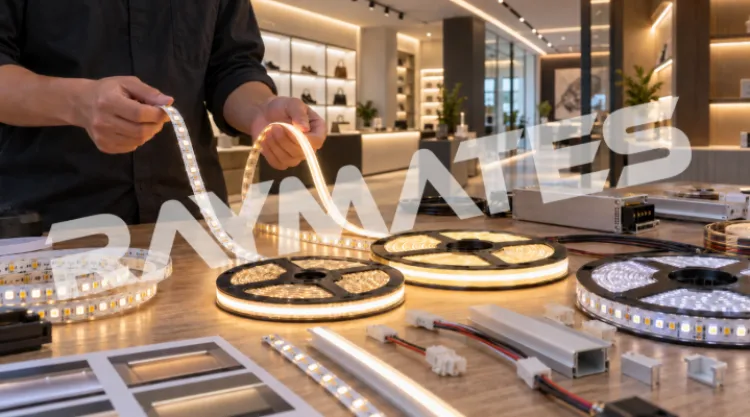
Raymates offers board widths from 3mm to 30mm and supplies connectors, extension cables, splitters, mounting clips, aluminum channels, controllers, and end caps.
A narrow board may fit a small channel, while a wider board may suit a higher-load design. Waterproof construction does not protect an unfinished cut end, so field joints still need sealing. Connector width, pin count, and current capacity must match the strip.
How Can You Reduce Installation Errors and Maintenance Costs?
The cheapest strip does not always produce the lowest project cost. Reopening ceilings after handover can cost more than careful planning.
Fewer Feed Points Simplify Installation and Servicing
A long-run strip can reduce unnecessary joints, but the system should remain modular. The aim is fewer well-planned connections, not one inaccessible circuit.
Good zoning reduces cable waste, connection work, and fault-tracing time. It also limits led strip voltage drop by keeping each branch within an approved range. Drivers and major junctions should remain accessible.
Installation Drawings and Videos Prevent On-Site Guesswork
Installers should receive an installation diagram, wiring plan, cable-routing drawing, driver schedule, cutting instructions, waterproof-joint details, and video guidance.
Raymates prepares these materials around the required length, route, voltage, control method, and site environment, reducing on-site improvisation.
Project Experience Reduces Procurement Risk
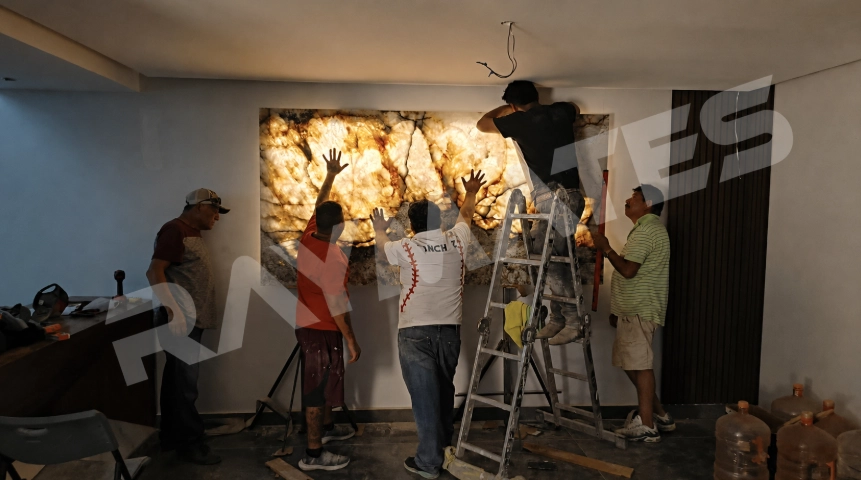
Raymates’ project records include hotel decorative lighting, multi-zone RGB lighting in an entertainment venue, and bridge-perimeter lighting. These cases show why product length, voltage, driver position, accessories, and final light effect must be reviewed together.
The company uses an ISO9001 quality management system, inspects products before shipment, and exports to more than 30 countries. Packaging, documentation, batch control, and shipping coordination can affect the installation schedule.
How Can Raymates Support a Complete Commercial Lighting Project?
A project is easier to purchase when the supplier can work from drawings, not only a product code.
Custom Specifications Follow the Actual Project Layout
Raymates’ customization service supports custom strip length, voltage, power, color temperature, board width, waterproof treatment, logo, packaging, and OEM or ODM requirements.
Customization should solve a site restriction, such as matching a narrow channel, reducing field cuts, or preparing labeled cable sets for repeated bays.
One-Stop Engineering Support Covers Product and Installation
Customers can submit lighting length, CAD or site drawings, installation photos, cable restrictions, input voltage, dimming requirements, waterproof grade, quantity, and destination.
Raymates can then match the strip, driver, controllers, connectors, cables, channels, installation method, wiring diagram, route plan, and installation video. This one-stop service suits contractors who need a coordinated lighting package.
Export Service and Contact Complete the Procurement Process
Prepare the drawing, strip length, environment, control method, destination, and delivery schedule. Use the Raymates contact channel to request product matching, wiring and route drawings, installation guidance, packaging details, and shipping options. Tax-inclusive delivery can be discussed for suitable routes, subject to destination and customs conditions.
Conclusion
Controlling led strip voltage drop starts before installation. Measure the route, divide the project into power zones, choose the operating voltage, complete LED driver sizing, confirm wire paths, and approve drawings before ordering. For long continuous lines, Super Long COB Strip can reduce connection points when matched to the actual load and site conditions. Raymates can support the project with customized products, installation diagrams, wiring solutions, route drawings, installation videos, export coordination, and accessory matching.
FAQ
Q1. How Can I Calculate LED Strip Voltage Drop for a Commercial Project?
A. Start with strip voltage, watts per meter, branch length, cable distance, wire size, and feed method. Calculate each branch separately, then check the strip, driver, connector, and cable against the route drawing.
Q2. Should Several LED Strip Rolls Be Connected End to End?
A. Usually not. End-to-end wiring can place downstream current through the first strip section and connector. Parallel branches, dual-end feeds, or local drivers are easier to control and maintain.
Q3. What Information Should I Send Before Ordering a Commercial LED Strip System?
A. Send the total lighting length, drawings, installation surface, cable route, input voltage, color and control requirements, waterproof needs, quantity, destination, and delivery schedule. These details allow the supplier to prepare a matched product list, wiring plan, installation diagram, and shipping proposal.