A useful LED Tape Buying Guide should help a commercial buyer prevent problems before the first production order. Price per meter does not show whether the tape will fit the profile, match the driver, or stay consistent in repeat orders. Project sourcing starts by turning drawings into a specification the factory can reproduce.
Raymates manufactures LED strip products for commercial and OEM/ODM applications. Its range covers voltages, board widths, accessories, and customization, with project drawing support. This LED Tape Buying Guide focuses on the checks that matter from inquiry through bulk production.
What Should Buyers Define Before Requesting an LED Tape Quote?
A factory cannot make a useful recommendation from “warm white LED tape” alone. Define the installation, visual target, electrical layout, and destination market first.
Application, Dimensions, and Installation Environment
A retail shelf, hotel cove, display cabinet, and outdoor detail impose different limits on width, cutting points, moisture protection, and access. Raymates supports board widths from 3 mm to 30 mm. For tight furniture details or under cabinet strip lighting, the Mini Size COB Strip is relevant where fit drives the specification. Buyers sourcing wholesale LED strip lights should send profile drawings and installation clearances.
Voltage, Power, and Driver Layout
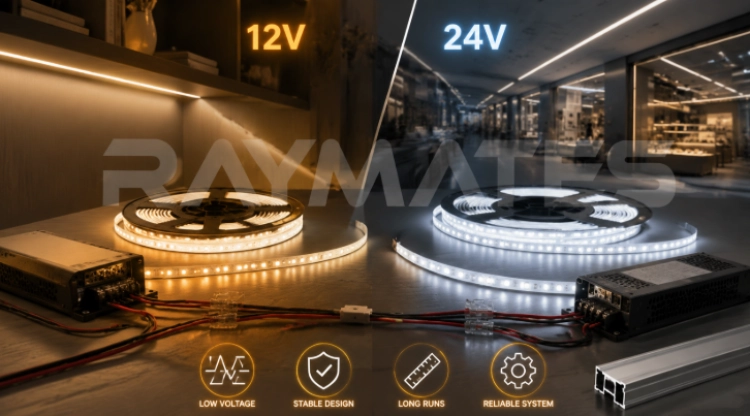
Voltage should be selected with wattage, run length, feed points, and driver location. Raymates works with low-voltage options including 12V and 24V and supports power customization. At the same power, 24V carries less current than 12V, which can reduce resistive loss. Still, a 24V COB LED strip light needs a run-length and feed-point review before production.
CCT, CRI, and Visual Acceptance Targets
CCT and CRI should be written into the approved specification with a color-tolerance target. LED strip specifications commonly use CCT, CRI, and SDCM. For color-critical retail projects, ask whether one-bin supply or a defined SDCM range can be maintained for the actual order.
Which LED Tape Construction Should Buyers Compare Before Sampling?
A practical led tape buying guide needs to look below wattage and CCT. PCB design, copper weight, and cutting pitch can change fixture performance.
COB and SMD Suit Different Lighting Priorities
COB is commonly evaluated where a continuous light line and reduced dotting matter. For retail counters or hotel details, Raymates’ Hot Selling COB Strip gives buyers a COB option to sample.
Diffuser depth, viewing distance, target brightness, and service method still matter. Buyers looking for a COB LED strip for retail display should approve the strip inside the actual profile rather than judge a loose sample.
PCB Width and Copper Weight Affect More Than Physical Fit
PCB width determines channel fit, while copper weight affects current carrying, voltage drop, and heat. Ask whether the PCB uses 2OZ, 3OZ, 4OZ, or another copper weight and whether it matches the circuit design.
Thicker copper is not automatically better; it must match width, circuit design, power, heat dissipation, and cost. For a narrow 5mm LED strip, trace layout can matter as much as nominal copper weight. A 24V COB LED strip light should be reviewed as an electrical design, not just a voltage label.
Cutting Pitch and Mechanical Fit Should Be Checked on the Real Drawing
Cutting LED strip lights on site is only simple when the cutting pitch matches the module dimensions. Check cut marks, connector clearance, bending direction, and minimum usable segment. For repeated display modules, the wrong pitch can create waste or extra joints. A good LED strip manufacturer should confirm these points against the drawing.
How Should Buyers Evaluate Electrical, Waterproofing, and Installation Details?
At this stage, the led tape buying guide becomes a system check: tape, driver, cable, connector, channel, sealing, and control should be reviewed together.
12V and 24V Should Be Selected by Run Length and Current
Longer runs often favor lower current, while short modules may prioritize cutting flexibility. Raymates’ range includes 12V and 24V options, so voltage can be matched to the layout. For wholesale LED strip lights used across repeated fixtures, ask the factory to mark feed points and driver positions before sample approval.
IP Rating Is Only One Part of Waterproof Reliability
An IP label does not show how cut ends, solder joints, connectors, and cable exits will be sealed. Waterproof construction can use silicone coating, sleeves, and sealed end caps.
A buyer comparing a waterproof LED strip manufacturer should ask how field connections are protected. For a waterproof COB LED strip light, approve sealing details before fixing the installation method.
Drivers, Connectors, and Aluminum Channels Should Be Specified as One System
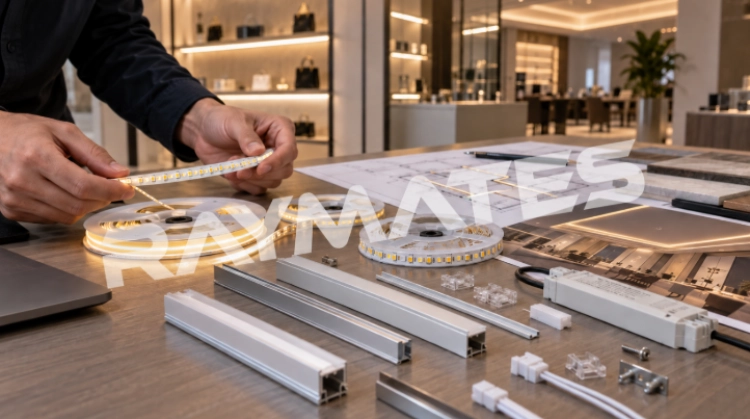
Raymates supports power supplies, controllers, connectors, extension cables, mounting clips, aluminum channels, splitters, and end caps; channels also assist with protection and heat dissipation.
The LED Strip S3/S5 Series can be compared where a conventional flexible strip format suits the project. For industrial LED strip lights or bulk LED strip lights, confirm driver loading, connector capacity, cable length, channel fit, and maintenance access together.
What Factory-Level Quality Checks Should Buyers Ask About?
A manufacturer-side led tape buying guide should go beyond the finished sample and ask how the approved electrical and optical result will be repeated in production.
PCB, SMT, and Solder-Joint Quality Need Process Control
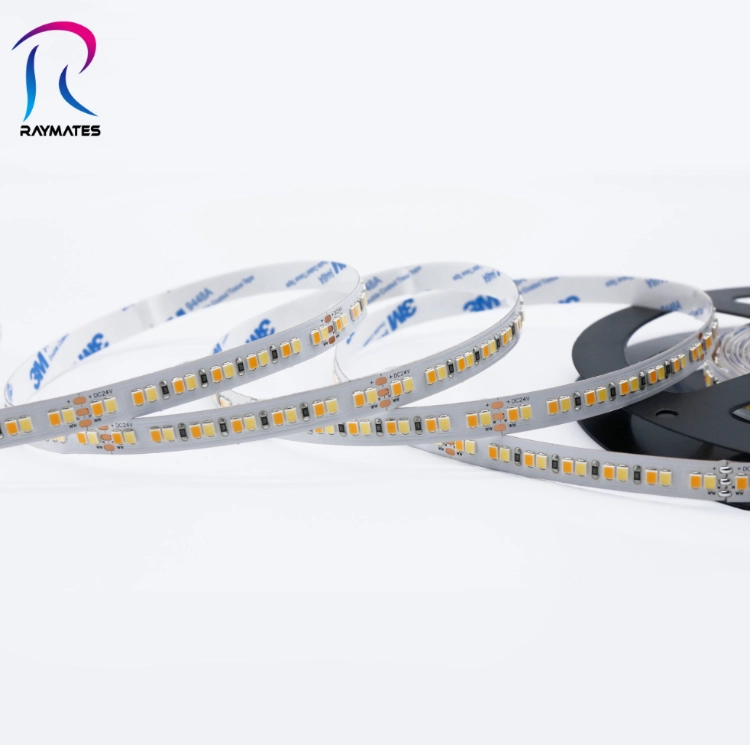
LED tape reliability depends on PCB traces, solder paste, component placement, reflow control, and joint condition. Raymates uses SMT and reflow processes, and solder paste and flux are part of flexible-circuit assembly.
Ask how the factory checks cold joints, excess solder, oxidized joints, damaged pads, and continuity. A buyer comparing an LED strip manufacturer should request the actual PCB copper specification rather than accept “thick copper PCB.”
Bin Control and Sample Approval Protect Batch Consistency
The approved sample should become a production reference for CCT, CRI, brightness, and dimming behavior. Raymates uses electrical and optical test equipment and applies 100% inspection before shipment.
For a COB LED strip for retail display, ask whether one-bin control or an agreed SDCM target can be maintained across the order and later replacements. This matters in shop displays, hotel joinery, and other installations where several illuminated sections sit in the same field of view.
Certifications, Inspection, and Batch Traceability Should Match the Destination Market
Certification should be checked against the exact SKU and destination market. Raymates works with UL, ETL, CE, RoHS, and TUV-related compliance and identifies products by model, specification, and batch.
A waterproof LED strip manufacturer or commercial LED tape supplier should clarify applicable documents, batch identification, and pre-shipment inspection. These checks become more important when the same project will require later replenishment.
What Should Buyers Expect After the LED Tape Specification Is Approved?
A practical led tape buying guide should finish with repeatability. Once a sample is accepted, its requirements should carry into production and later orders.
Match the Product Family to the Final Project Requirement
Hot Selling COB Strip suits projects where a continuous COB light line is the priority. Mini Size COB Strip is relevant when channel width dominates. LED Strip S3/S5 Series can be evaluated for conventional flexible-strip applications.
Installation space, voltage, cut length, color target, waterproofing, and service access should decide the family. This is especially important when sourcing wholesale LED strip lights, because a small mismatch repeated across hundreds of fixtures can become an installation problem.
Customization Should Cover Engineering, Not Only Product Dimensions
B2B customization may include voltage and power matching, project drawings, OEM/ODM requirements, and sample confirmation. Raymates’ Customize service supports project-specific engineering communication.
This helps when repeated fixtures require the tape, driver layout, connectors, and drawing to stay aligned rather than treating each component as a separate purchase.
A Complete RFQ Helps the Manufacturer Quote the Right Solution
An RFQ should state application, quantity, run lengths, voltage, target power, PCB width, copper weight if required, CCT, CRI, bin or SDCM target, IP requirement, control method, drawings, destination market, and sample quantity.
Use this LED Tape Buying Guide as a pre-RFQ check so suppliers are compared on engineering fit, not only price per meter.
If your project has narrow profiles, long runs, color-matching requirements, moisture exposure, or a custom driver layout, send the drawing and target specification when you contact Raymates. The useful question is which construction can be produced and repeated against the project requirement.
FAQ
What Should Be Included in an LED Tape Buying Guide for Commercial Projects?
A commercial LED Tape Buying Guide should cover application, voltage, run length, PCB width, copper weight, CCT, CRI, color tolerance, IP requirement, cutting pitch, drivers, connectors, certification, sample approval, and batch consistency. Factory process matters as much as the catalog specification.
Is 12V or 24V Better for Commercial LED Tape?
Neither voltage is automatically better. Short modules may favor cutting flexibility, while longer runs often benefit from the lower current of 24V at the same power. A commercial LED tape supplier should review feed points, cable distance, and driver location before voltage is fixed.
How Do I Choose an LED Strip Manufacturer for a Bulk Order?
Use the LED Tape Buying Guide criteria to compare process control, not just unit price. Ask about PCB copper weight, solder-joint inspection, bin control, sample approval, waterproofing, exact-SKU certification, batch identification, and repeat-order consistency. These checks matter when sourcing bulk LED strip lights for repeated commercial installations.