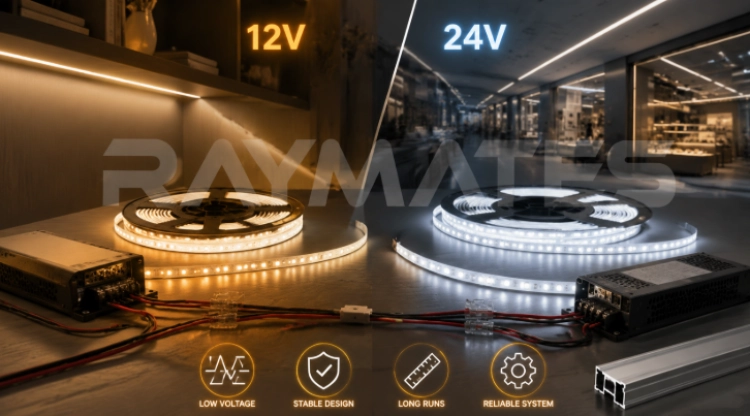
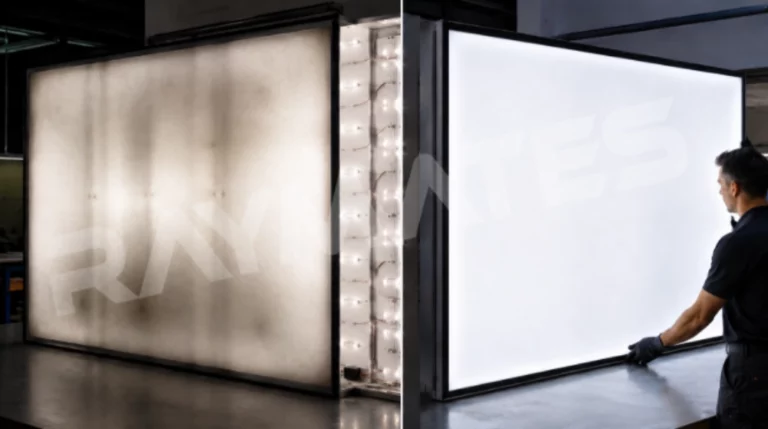
A low-voltage strip can look fine on a sample bench and still lose brightness after installation. LED Strip Voltage Drop happens because current passes through PCB traces, cables, connectors, and terminals that add resistance. In commercial LED strip lighting, that can mean dimmer ends, more feed points, and more installation work.
Raymates supplies COB LED Strip, low-voltage LED Strip, LED Driver, connectors, aluminum channels, and project support. Its low-voltage range includes 12V and 24V, so buyers can match voltage to run length, cutting needs, driver layout, and application rather than using one voltage everywhere. This is especially useful for wholesale LED strip for projects where the whole electrical system must be planned together. For many buyers, the 12V vs 24V LED strip question starts here.
Why Does LED Strip Voltage Drop Matter in Commercial Projects?
Voltage drop becomes more important as run length and current increase.
Voltage Drop Changes Brightness Along the Run
Copper traces, cables, connectors, and terminals all create resistance. At the same power, 24V draws about half the current of 12V. Lower current reduces resistive loss, so led strip voltage drop is generally easier to manage. PCB design, copper weight, wattage, cable size, and feed method still affect the final result.
Longer Runs Increase Power-Distribution Demands
Long runs require careful driver placement, cable routing, and feed points. First calculate the physical run and separate continuous sections from branches. A useful planning reference is how to calculate the right LED strip length.
For LED strip wiring for commercial projects, fewer joints usually mean easier servicing.
Commercial Systems Need System-Level Planning
A strip, driver, cable, connector, and mounting channel work as one system. The LED strip power supply must match the strip voltage, while the wiring must suit the total load and distance. Buyers should also state waterproofing and service-access requirements.
How Do 12V and 24V LED Strips Compare for Commercial Use?
The practical 12V vs 24V LED strip decision is mainly about current, distance, and cutting flexibility. In commercial LED strip lighting, these factors affect both installation and maintenance. The table below is a selection reference; actual run length and cutting pitch depend on product design.
| Comparison Factor | 12V LED Strip | 24V LED Strip |
| Core Advantage | High flexibility; more cutting points | Lower voltage drop; more uniform brightness over distance |
| Typical Maximum Continuous Length | About 5 m (16.4 ft) | About 10 m (32.8 ft); some professional products can reach 24 m (80 ft) |
| Voltage Drop | More noticeable; far end may become dimmer | Lower; brightness is easier to keep consistent |
| Current and Heat | Higher current at the same power; more current-related heat | About half the current at the same power; lower current-related heat |
| Cutting-Point Spacing | Often smaller, such as 50 mm | Often larger, such as 100 mm |
| Typical Applications | Short runs, under-cabinet, automotive, marine | Commercial lighting, long strips, architectural outlines, retail displays |
For project approval, voltage should not be selected from nominal run length alone. Buyers should confirm the rated wattage per meter, cutting unit, maximum recommended feed length, PCB specification, driver capacity, and connection method for the exact strip model. A 24V design may reduce current and simplify long runs, but the final feed spacing still depends on strip power, conductor resistance, connector quality, and installation temperature. These values should be confirmed on the selected Raymates product specification before the wiring layout is frozen.
24V Reduces Current at the Same Power Level
Power equals voltage multiplied by current. If two systems use the same power, moving from 12V to 24V halves the current. That is the main reason a 24V LED strip for long runs is easier to distribute. Lower current reduces losses across the same conductor resistance, helping control led strip voltage drop. For commercial installations that require longer continuous runs, a 24V High Efficiency COB LED Strip can help reduce current-related losses while maintaining more consistent brightness distribution across the lighting layout.
12V Remains Practical for Short and Compact Layouts
12V suits short cabinet sections, compact displays, vehicle or marine systems, and frequent cutting. Raymates’ Hot Selling COB Strip is available in DC12V and DC24V with different cutting units, helping specifiers balance cutting flexibility against run length.
24V Gives Larger Projects More Electrical Headroom
As project size grows, lower current makes 24V easier to design around. It can also reduce current-related heating at wiring and connection points, supporting system stability; LED lifetime still depends on thermal design and component quality.
For high-volume commercial projects, fewer corrective feed points and hidden connections can matter more than a small difference in strip price. For retail displays, architectural outlines, and decorative commercial lighting, a High Brightness COB LED Strip can be selected when visual impact and uniform illumination are key design requirements.
Why Is 24V Usually the Better Choice for Long Commercial Runs?
Long commercial runs make cable resistance, connection quality, and driver location more critical; 24V usually gives the installer more margin.
Lower Current Supports More Stable Power Distribution
A 24V LED strip for long runs fits retail display lighting, hotel corridors, cove lighting, commercial shelf lighting, and architectural outlines. Lower current makes the electrical path less demanding than an equivalent 12V layout.
For humid or outdoor installations, buyers should specify voltage, feed distance, waterproof grade, and connector protection together, because waterproofing alone does not prevent electrical losses.
Fewer Feed Points Can Reduce Installation and Maintenance Work
Every extra feed point adds cable, joints, labor, and another service location. For LED strip wiring for commercial projects, a simpler layout can reduce ceiling access, cabinet drilling, and troubleshooting. This is one reason led strip voltage drop affects total project cost, not only brightness.
Super Long COB Strip Supports Extended Runs
Where continuous length is the main constraint, Raymates’ Super Long COB Strip is the more relevant option to evaluate. The product family targets extended COB runs and applications such as corridor lighting, shelf lighting, cove lighting, signage, and architectural outlines. In projects where brightness consistency over distance is important, a High Lumen COB LED Strip can be evaluated together with voltage selection, driver capacity, and installation conditions.
Confirm the actual run, input point, wattage, waterproofing, and maintenance access before approval.
How Should Buyers Compare Driver Availability and Total Project Cost?
Strip price is only one line in a commercial bill of materials; voltage also affects wiring, feed points, and driver layout.
Strip Price Is Only One Part of Installed Cost
Compare strip, driver, cable, connectors, mounting accessories, labor, and service access together. A 12V design can be economical for short runs. As runs become longer, extra wiring needed to manage led strip voltage drop may shift the cost balance toward 24V.
Maintenance also matters: a hidden connection is harder to service than one in an accessible driver zone.
Voltage and Driver Must Be Matched as One System
A 12V strip needs a suitable 12V supply; a 24V strip needs a suitable 24V supply. The LED strip power supply must also suit the connected load and installation conditions. The procurement advantage of 24V is not that every driver is cheaper, but that long-run layouts may need fewer feed zones.
Raymates’ LED Driver can be considered together with connectors, extension cables, mounting clips, aluminum channels, and other installation accessories.
24V Often Improves Total System Economics at Scale
The case for 24V is not that every component is cheaper. Lower current can simplify larger installations and reduce corrective feeds and service points.
In humid or outdoor projects, voltage, waterproof grade, connection sealing, and driver location should be specified as one electrical system.
Which Voltage Should You Specify for Your Commercial Project?
Start with run length and load, then check cutting pitch, driver location, waterproofing, and service access.
12V Fits Short Runs and Fine Layout Control
Choose 12V for short runs, compact layouts, frequent cutting, or existing 12V electrical systems. Typical cases include under-cabinet lighting, small retail displays, vehicle lighting, and marine layouts.
24V Fits Most Medium-to-Long Commercial Runs
For most medium-to-long low-voltage projects, 24V is the stronger starting point. It reduces current at the same power and makes led strip voltage drop easier to control. Super Long COB Strip is more relevant when extended continuous lighting is central to the design.
Raymates Supports Specification, Installation, and After-Sales Service
Raymates supports OEM/ODM production, customized LED strip solutions, project and installation drawings, installation guidance, and online support. Project specification can cover voltage, power, driver, connectors, extension cables, mounting hardware, and controls. Products are inspected before shipment.
For buyers dealing with LED Strip Voltage Drop, the useful question is not only “12V or 24V?” but “Which complete electrical layout will stay stable, installable, and serviceable?”
If you are preparing a BOQ, shop drawing, sample request, or purchasing specification, provide total run length, branch layout, wattage target, installation environment, waterproofing, and control method when you contact Raymates. That gives the team enough detail to match voltage, driver, connectors, and installation approach.
FAQ
What Causes LED Strip Voltage Drop in Long Commercial Runs?
Resistance in PCB traces, wires, connectors, and terminals lowers voltage along the circuit. Higher current and longer distance increase the effect. Correct conductor sizing, shorter feed distance, and planned power injection help control LED Strip Voltage Drop.
Is 24V Always Better Than 12V for LED Strip Lighting?
No. 24V is usually more practical for medium-to-long runs because it carries less current at the same power. 12V can suit short installations, tighter cutting requirements, and existing 12V systems. Check run length, wattage, cutting pitch, and driver placement.
How Should I Choose a Driver for a 12V or 24V LED Strip?
Match driver output voltage to the strip, then calculate connected power and place the driver where cable distance and servicing remain manageable. For multi-run systems, divide loads into sensible circuits and specify the driver, connectors, cables, and strip together.