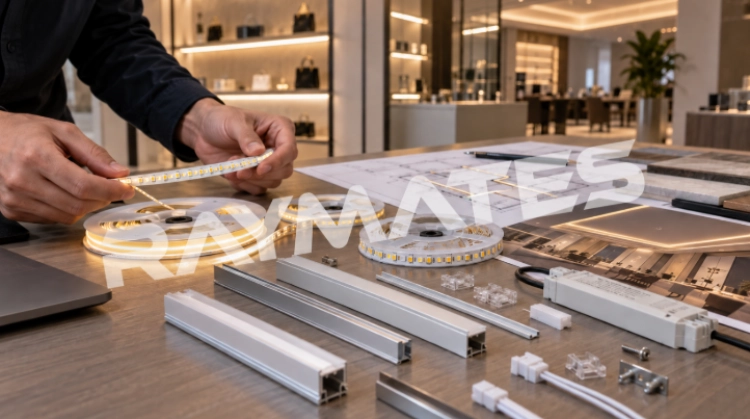
Choosing LED strip lighting for a store starts with the merchandise, fixture geometry, and electrical layout—not with wattage alone. This commercial LED strip lights selection guide focuses on the specifications that affect real retail projects: CRI, CCT, output, LED density, voltage, IP protection, driver sizing, and installation space.
Raymates develops LED strips and related lighting products for commercial, industrial, and residential applications. Its broader low-voltage range covers 3V, 5V, 12V, 24V, 36V, and 48V, while power and board width can be adjusted for different project requirements. Board widths across the product range span 3–30 mm. This flexibility is useful in retail LED strip lighting, where a long shelf, a narrow display cabinet, and an ambient ceiling cove may require very different specifications.
What Should Retail Buyers Check Before Choosing LED Strip Lights?
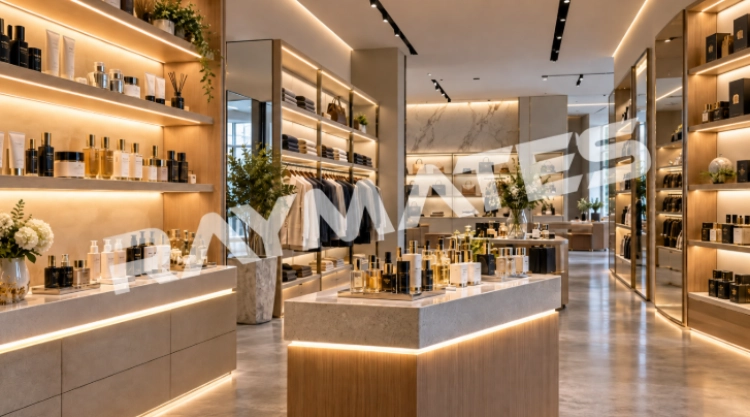
A retail project usually contains several lighting conditions at the same time. Shelf edges are viewed at close range, cabinets may have very little installation depth, and long wall displays can create more demanding power-distribution conditions. Specifications should therefore be matched to each area rather than copied across the whole store.
Start with the Retail Application, Not Just the Strip Specification
Begin by separating merchandise shelves, display cabinets, checkout counters, feature walls, ceiling coves, and general circulation areas.
For retail shelf lighting, the source may sit only a short distance from glossy packaging or polished surfaces, so visible LED dots and color inconsistency become easy to notice. LED strip lights for display cabinets also need to fit the available channel width while leaving enough space for cables and connectors.
Long architectural runs create a different problem. There, voltage, driver position, feed points, cable size, and maintenance access become more important than simply choosing the narrowest strip.
Use a Retail LED Strip Selection Checklist
The following values work better as screening references than as universal pass/fail limits.
| Dimension | What to Check | Commercial Project Guidance |
| Light Quality | CRI | CRI ≥90 is a useful target for merchandise displays; CRI ≥80 may be sufficient in general areas |
| Light Quality | CCT | 2700K–3000K for warmer spaces, around 4000K for neutral presentation, 5000K+ for a cooler, cleaner appearance |
| Performance | Power | Around 12W/m or above may be considered for higher-output accent areas, but actual lumens and mounting conditions matter more |
| Performance | LED Density | ≥120 LEDs/m can be used as an initial screening reference; COB is worth considering where dotting must be minimized |
| Electrical | Voltage | 24V is often practical for longer commercial runs |
| Environment | IP Rating | IP20 for dry interiors; IP65 for damp locations; IP67 where stronger water protection is needed |
| Installation | Heat Dissipation | Match the strip to an appropriate aluminum profile and mounting surface |
| System | Power Supply | Driver voltage and capacity must match the strip and connected load |
| Procurement | Supplier | Check samples, batch control, applicable certification, technical support, and after-sales service |
The 12W/m and 120 LEDs/m figures should not be treated as universal minimums. Actual Raymates products show why. A strip can use a lower wattage while still offering dense COB construction and useful output. Used this way, the commercial LED strip lights selection guide stays focused on installed performance instead of isolated numbers.
Match Strip Construction to Viewing Distance and Installation Space
COB construction is particularly useful where customers can see the light line directly. Raymates’ Hot Selling COB Strip uses 480 LEDs/m in its listed configuration, with DC12V/24V options, 10W/m with a 14W/m option, 90–120 lm/W luminous efficacy, CRI above 90, a 180° beam angle, and an 8 mm PCB. Its available color temperatures include 3000K, 4000K, and 6000K.
Those figures give buyers something more useful than the label “COB”: they can compare board width, power, output, color rendering, and cut length against the real fixture.
How Do CRI and CCT Affect Merchandise Presentation?
Retail lighting changes how customers perceive fabric, packaging, wood, cosmetics, metal finishes, and other surfaces. CRI and CCT should therefore be specified according to the merchandise and store atmosphere rather than chosen only from a standard catalog setting.
CRI ≥90 Is a Strong Starting Point for Merchandise Displays
CRI ≥90 is a practical target where accurate color appearance is important. General circulation areas may not require the same level.
For a buyer comparing a high CRI LED strip for retail, the number alone is not enough. The product should also be checked inside the intended fixture because diffuser material, reflections, ambient light, and mounting distance affect what the customer actually sees.
The Hot Selling COB Strip provides CRI >90, which makes it relevant to close-view merchandise applications where color reproduction and a continuous light line are both required.
Different CCTs Create Different Retail Atmospheres
Warm light around 2700K–3000K tends to create a softer visual environment. Around 4000K produces a more neutral appearance, while 5000K and above creates a cooler, crisper impression.
The product options also make this choice practical rather than theoretical. Hot Selling COB Strip offers 3000K, 4000K, and 6000K, while Mini Size COB Strip also offers these three CCTs. Super Long COB Strip includes 2700K as well as 3000K, 4000K, and 6000K options.
For retail LED strip lighting, a sample should be tested against the actual merchandise before a large batch is approved.
Batch Consistency and Sample Approval Matter in Multi-Fixture Projects
A single good sample does not prove that several shelves or cabinets will look identical when products from different batches are installed next to each other.
For a high CRI LED strip for retail, buyers should confirm CRI, CCT tolerance, output, electrical specification, and color consistency for the production configuration. Raymates’ COB specification system includes CRI, CCT, SDCM, luminous efficacy, power density, and thermal management as relevant evaluation items.
This matters especially in long cosmetics counters, fashion walls, or repeated display modules where neighboring light lines are viewed together.
How Much Brightness and LED Density Does a Retail Display Need?
Brightness should be judged at the merchandise surface, not from W/m alone. Shelf depth, diffuser transmission, mounting distance, ambient illumination, surface color, and beam distribution all influence the result.
Evaluate Wattage Together with Lumen Output and Mounting Distance
A project checklist may use around 12W/m as a starting point for stronger accent lighting, but it should not become a purchasing threshold.
Hot Selling COB Strip, for example, has a listed 10W/m configuration with 90–120 lm/W luminous efficacy and a 14W/m option. That means simply rejecting every strip below 12W/m could remove a configuration that may still meet the required installed light level.
For retail shelf lighting, compare output, efficacy, profile depth, diffuser, viewing distance, and heat conditions together. These checks are what turn a commercial LED strip lights selection guide into an actual fixture specification.
Higher Density Does Not Automatically Guarantee Better Uniformity
The 120 LEDs/m figure in a preliminary checklist is useful only as a coarse reference. It does not mean that every 120 LEDs/m strip will look equally smooth.
Raymates’ Hot Selling COB Strip, Mini Size COB Strip, and Super Long COB Strip all have configurations at 480 LEDs/m. Even then, the final visual result still depends on COB construction, diffuser distance, channel depth, mounting alignment, and the surface being illuminated.
Higher density helps reduce spacing between light sources, but the assembled fixture should be the final basis for approval.
Test the Complete Strip, Profile, and Diffuser Assembly
This is especially important for LED strip lights for display cabinets, where installation space can be very limited.
Raymates’ Mini Size COB Strip has a standard 3 mm PCB, with 2.5 mm, 4 mm, and 5 mm width options. Its listed specification includes 480 LEDs/m, CRI 90, a 25 mm cutting unit, 5W/m with 6W/m and 7W/m options, and 80–90 lm/W luminous efficacy.
These dimensions make it suitable for slim channels and restricted display-case edges, but the buyer still needs to confirm connector clearance, cable exit direction, heat-transfer surface, and diffuser depth.
How Should Voltage, IP Rating, and Driver Design Be Matched?
Electrical design and environmental protection should be considered together because they affect installation labor, reliability, and future maintenance. A strip that looks correct in a sample can still create problems if the driver layout or wiring plan is poorly matched.
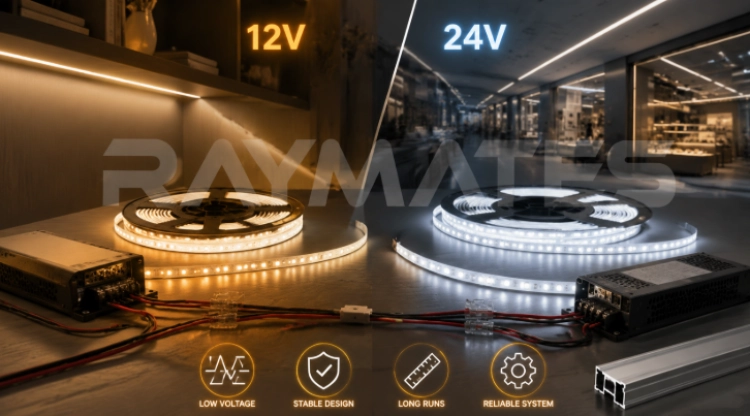
24V Is a Practical Starting Point for Longer Retail Runs
For the same power:
P = V × I
A 12W load draws about 1A at 12V and 0.5A at 24V. Lower current can make voltage-drop management easier, although cable length, conductor size, feed position, and total system load still need to be calculated.
This is why a 24V LED strip for long runs is often a practical starting point rather than an automatic rule.
Raymates also has a commercial hotel lighting example in which Natural White COB LED Strips were operated on a 24V DC system with a 240W 24VDC power supply. The project does not prove that every retail installation should use 24V; it demonstrates that strip voltage, driver capacity, and lighting layout need to be treated as one system.
Feed Points and Driver Capacity Control Long-Run Performance
For long shelving rows and continuous architectural lines, Raymates’ Super Long COB Strip gives buyers a more concrete configuration to evaluate.
The RM-COBW480-24V10-20M specification uses DC24V, 480 LEDs/m, a 10 mm PCB, 10W/m power, 680 lm/m output, a 50 mm cutting unit, and a standard length of 20 m per roll. CRI is above 90.
This makes it relevant when evaluating a 24V LED strip for long runs or continuous retail shelf lighting, but feed points, cable routes, driver capacity, and actual installation length still need to be checked rather than assumed from the reel length alone.
IP Protection and Heat Dissipation Affect Reliability
IP rating should follow the installation environment. IP20 is appropriate for normal dry interior applications, while IP65 or IP67 may be required where moisture exposure increases.
Hot Selling COB Strip has IP20 as its base configuration with IP65, IP67, and IP68 options. Mini Size COB Strip is listed as IP20. The standard Super Long COB Strip specification is also IP20, so waterproof treatment should be confirmed for the exact version before using it in damp locations.
For a waterproof COB strip light, protection cannot stop at the strip jacket. Cut ends, connectors, cable exits, and sealing workmanship must preserve the intended protection level.
Aluminum channels also provide a physical mounting surface and help transfer heat away from the strip. Raymates provides a separate guide on COB strip operating temperatures for projects where thermal conditions need closer evaluation.
What Should Buyers Check Before Ordering from an LED Strip Supplier?
Once the optical and electrical specifications are clear, purchasing should move from generic product comparison to production control. Samples, certification, accessories, drawings, and batch requirements should be agreed before bulk ordering.
Samples, Certifications, and Quality Control Reduce Procurement Risk
A production sample should match the intended voltage, CCT, CRI, wattage, PCB width, waterproof structure, cut length, and connector method.
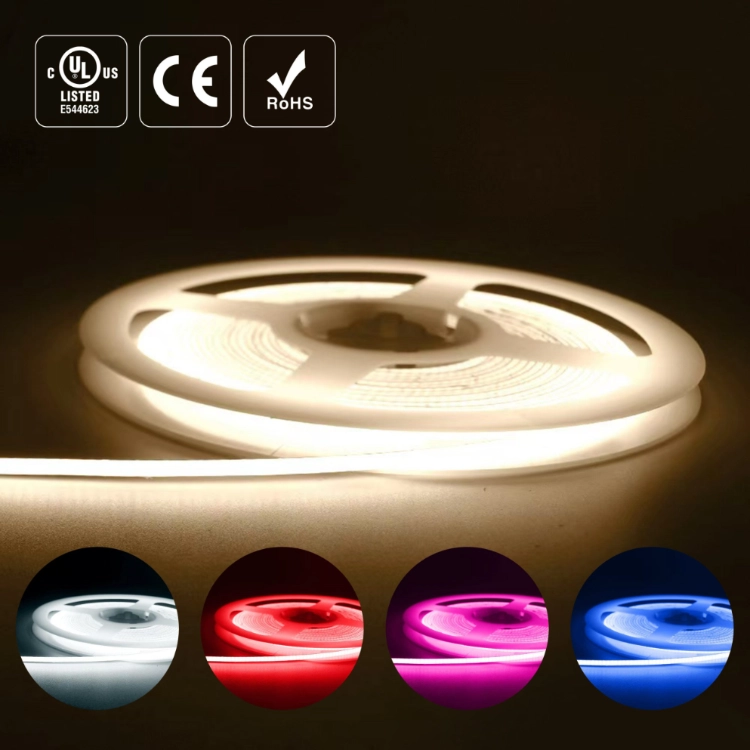
Raymates operates an ISO9001 quality management system and conducts 100% product inspection before shipment. Its company documentation includes UL, ETL, CE, RoHS, and TUV certifications. Buyers should still confirm which certification applies to the exact model and configuration being ordered rather than assuming every variation carries the same approval.
For a waterproof COB strip light or large wholesale project, the sample should also include the intended sealing and connection method.
Match the Raymates Product Family to the Installation
The three products serve different project constraints rather than competing on one specification.
| Product | Relevant Listed Specifications | Retail Use Case |
| Hot Selling COB Strip | 480 LEDs/m, 12V/24V, 10W/m with 14W/m option, CRI >90, 8 mm PCB, 3000K/4000K/6000K | General displays where smooth output, CRI, and moderate profile width matter |
| Mini Size COB Strip | 480 LEDs/m, 3 mm PCB with 2.5/4/5 mm options, CRI 90, 25 mm cut length | Narrow cabinets, slim shelves, furniture grooves, compact display structures |
| Super Long COB Strip | 24V, 480 LEDs/m, 10W/m, 680 lm/m, 10 mm PCB, 20 m standard roll | Extended shelves, long coves, and continuous commercial runs |
For retail LED strip lighting, this type of comparison is more useful than ranking the products as “better” or “worse.” The correct choice follows viewing distance, available space, run length, environmental exposure, and the required electrical layout.
Send a Complete Project Specification Before Bulk Ordering
A useful RFQ should state the store application, shelf or cabinet dimensions, total run length, CRI target, CCT, voltage, expected output, IP requirement, PCB or profile space, driver location, control method, and quantity.
Raymates can also provide customized lighting solutions, project drawings, and installation drawings, while its product range supports voltage, power, and dimensional adjustments.
Giving these details early allows the strip, driver, connectors, aluminum profile, and wiring arrangement to be checked as one system instead of solving conflicts during installation.
Before moving to production, use the commercial LED strip lights selection guide above to prepare the key dimensions and electrical requirements. If the main difficulty is choosing between strip width, run length, CCT, waterproofing, or driver layout, send those project details when you contact Raymates so the product configuration can be checked against the actual retail installation.
FAQ
Is CRI 90 Necessary for Every Retail LED Strip Installation?
No. CRI ≥90 is a useful target for areas where merchandise color needs to be reproduced accurately, such as clothing, cosmetics, and detailed display products. General circulation or background lighting may use CRI ≥80 where the visual requirement is lower. A high CRI LED strip for retail should still be tested with the final CCT, diffuser, merchandise, and surrounding materials.
Is 24V Always Better Than 12V for Retail LED Strip Lighting?
No. 24V is often easier to work with on longer runs because equivalent power requires less current, but the correct choice depends on strip design, total length, cable size, feed points, and driver location. Short display cabinets may work well with either voltage when the system is properly designed.
What Specifications Should I Send to an LED Strip Manufacturer Before Ordering?
For buyers using a commercial LED strip lights selection guide, the minimum project brief should include application, dimensions, run length, CRI, CCT, power or output target, voltage, IP rating, profile space, driver arrangement, control requirements, and order quantity. For repeated store installations, also confirm production samples and batch consistency before approving volume production.