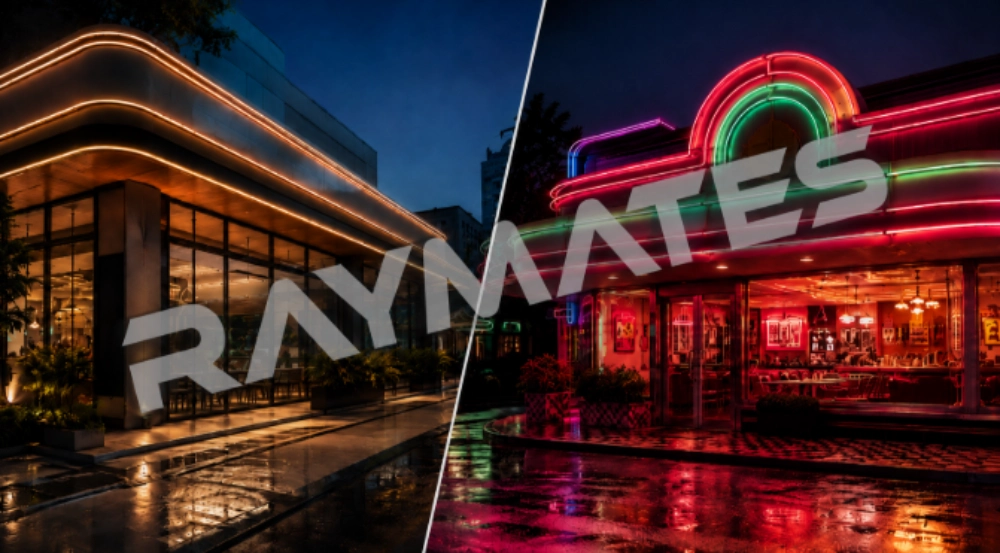
For most commercial outdoor signs, LED Neon Flex is the more practical choice when the project needs lower breakage risk, simpler electrical work, easier maintenance, and repeatable sign production. Traditional glass neon still has a place where exposed glass tubes and a hand-bent retro look are part of the design itself.
The real purchasing decision is not simply which light looks brighter. Buyers need to compare outdoor durability, voltage, operating cost, installation access, bend direction, and the final viewing effect.
Raymates manufactures LED strips, LED neon, LED sheets, wall washers, and related lighting accessories for commercial and architectural projects. Its manufacturing system includes ISO9001 quality management and product inspection before shipment. The company has also obtained certifications including UL, ETL, CE, RoHS, and TUV across its product portfolio. For a commercial sign order, however, the certificate applicable to the exact model and destination market should still be confirmed before production.
What Are the 6 Main Factors to Compare Before Choosing Outdoor Neon?
For outdoor neon signage, price is only one part of the decision. A sign that costs less at purchase but requires difficult installation or repeated specialist repairs may become more expensive over its operating life.
The following comparison gives buyers a practical starting point.
A Six-Factor Comparison for Commercial Signage
| Comparison Factor | LED Neon Flex | Traditional Glass Neon |
| Core Advantage | Lower breakage risk, low-voltage options, simpler servicing | Distinct hand-bent tube appearance and traditional neon character |
| Cost | Reference custom-sign range around CAD 200–800; reference power around 10–20 W | Reference range around CAD 5,000–9,000+; reference power around 50–100 W |
| Durability and Safety | Flexible silicone or PVC construction; common 12V/24V DC formats | Rigid glass is easier to damage during transport and installation; electrical work is more specialized |
| Performance and Lifespan | Reference lifespan around 50,000–100,000 hours; about 210 lm/m | Reference lifespan around 8,000–30,000 hours; about 197 lm/m |
| Installation and Maintenance | Profiles, clips, connectors, and drivers simplify installation and replacement | Tube forming, wiring, and repairs normally require specialist skills |
| Customization and Appearance | Letters, logos, curved outlines, RGB effects, and uniform linear light | Strong retro character and visible handcrafted tube form |
| Environmental Factors | Reference energy saving of 70%–90%; quiet operation and no fragile glass tube | Higher operating demand in many installations; transformer noise may occur |
These figures should be treated as project reference ranges, not fixed values for every sign. Size, color, mounting structure, local labor, controls, and electrical design can change the actual cost.
LED Neon Flex Fits Most Low-Risk Commercial Projects
Retail stores, restaurants, offices, hotels, and shopping centers usually need commercial neon signs that can be installed and serviced without turning every repair into specialist glass work.
For these projects, LED neon flex lights offer a useful balance between visual continuity and practical installation. It can follow lettering and logo outlines while using mounting clips, profiles, connectors, and conventional low-voltage power architecture.
It is also easier to standardize when one custom neon signage design needs to be repeated across several stores or branches.
Glass Neon Still Has a Place in Aesthetic-Led Projects
Glass should not be dismissed simply because newer lighting technology is available. A retro restaurant, heritage storefront, exhibition piece, or art installation may specifically need the exposed tube character of traditional neon.
In a glass neon vs LED neon decision, start with the visual brief. If hand-formed glass is essential to the concept, the extra fabrication and service work may be justified. If repeatability, lower handling risk, and easier maintenance matter more, flexible LED construction is usually easier to manage.
Which Option Handles Outdoor Conditions With Less Risk?
Outdoor signs deal with rain, UV exposure, dust, temperature changes, cable movement, and repeated thermal cycling. Waterproof neon LED strip performance therefore depends on more than the outer silicone jacket. End sealing, cable entry, mounting, and driver placement also affect reliability.
Low-Voltage LED Neon Reduces Electrical and Handling Risk
Raymates offers DC12V and DC24V configurations within its neon range, while its 360° Multi-glowing Neon Light can be specified in 12V, 24V, or 48V.
These options let engineers match voltage to cable distance, driver position, and connected load instead of forcing every project into one electrical layout. A DC 24V LED neon flex configuration can help balance cable distance, driver position, and connected load. They are particularly useful for outdoor neon signage where the driver may be located away from the letters or behind a façade panel.
Raymates has obtained UL, ETL, CE, RoHS, and TUV certifications within its product portfolio. Buyers should confirm which certificate applies to the exact ordered model and destination market rather than assuming that every approval applies to every configuration.
The same rule applies to maximum run length. A 24V system should not automatically be treated as a fixed 10-meter single-feed solution. Cable gauge, wattage, conductor resistance, feed position, and acceptable voltage drop all affect how far one section can run before another power feed is needed.
IP67 and Weather-Resistant Silicone Support Outdoor Use
The Multi-glowing Neon Light uses integrated silicone construction with IP67 protection. Its silicone material is designed to resist UV exposure, yellowing, alkaline environments, and heat.
That makes it relevant to waterproof neon lighting used on façades, outdoor branding features, building outlines, and exposed commercial displays.
IP67 still does not make an installation automatically waterproof. Cable entries, cut sections, connectors, and end caps remain possible moisture-entry points. Each termination should be sealed correctly, and installers should avoid creating locations where rainwater can sit around the cable or connector.
For public-facing signs where mechanical impact is a concern, buyers should also request model-specific impact-resistance information rather than assuming an IK rating that has not been confirmed for the selected product.
Flexible Construction Reduces Transport and Installation Damage
Rigid glass tubes require careful packing, handling, and installation. An outdoor LED neon flex strip reduces that risk because its luminous body can bend within its designed direction instead of relying on fragile glass.
This is useful for long letters, large logo outlines, curved façades, and repeated commercial neon signs. It also simplifies transport between the factory, sign workshop, and final site.
Flexibility has limits, however. Led neon flex should not be twisted or forced against its intended bending plane. Incorrect bending can distort the light line and place unnecessary stress on the internal structure.
Which Option Costs Less to Install, Run, and Maintain?
A useful cost comparison includes fabrication, electrical work, installation labor, energy use, access equipment, spare parts, and future servicing. This matters most for signs mounted high on façades or above entrances, where a small electrical fault can still require significant access work.
Raymates Multi-Glowing Neon Provides a 10 W/m Reference Configuration
The Multi-glowing Neon Light 360° configuration operates at 10 W/m and delivers 870 lm/m with CRI above 90. It uses DC24V as a standard reference voltage, with 12V and 48V options also available.
These figures belong to that configuration rather than every led neon flex product.
For a real project, total power should be calculated from the approved sign length. A long logo should also be divided into practical electrical sections so the designer can confirm cable size, driver capacity, feed points, and expected voltage drop before fabrication.
That approach gives buyers a more useful glass neon vs LED neon cost comparison than using one generic wattage figure for every sign.
Profiles and Clips Simplify Commercial Installation
Raymates provides aluminum profiles, mounting clips, end caps, connectors, and extension cables for flexible lighting installations.
The Multi-glowing range also supports different mounting structures, including profiles for straight sections and flexible grooves for curved layouts.
For neon sign installation, installers should mark mounting points, cable exits, driver locations, and removable sections on the drawing before the sign is manufactured. A visually clean installation can become expensive to repair if the driver or connector is permanently hidden behind cladding.
Maintenance Access Should Be Planned Before Fabrication
Many maintenance problems come from access rather than from the light source itself.
Drivers should be placed where technicians can reach them. Junctions should not be buried unnecessarily. End caps and cable entries should remain inspectable where the installation allows.
This is one reason led neon flex works well for low-maintenance commercial projects. Electrical parts can be separated into serviceable sections instead of treating the entire sign as one permanent assembly.
How Do Shape, Glow Angle, and Brand Design Affect the Choice?
Not every neon profile bends in the same direction, and not every sign is viewed only from the front. Custom neon signage should therefore be selected according to both the geometry of the lettering and the direction from which people will see it.
Top Bend Neon Fits Letters, Logos, and Front-Facing Curves
Raymates’ Top Bend Neon Light is suited to projects where the required curve matches the product’s bending plane.
This can include lettering, logos, wall graphics, and architectural outlines. The key is to settle the bending direction at the drawing stage.
If the wrong neon structure is selected, installers may try to force the material into a curve it was not designed to make. That can affect the appearance and increase stress on the strip.
For projects where this distinction is unclear, the guide on side bend or top bend LED strips can help clarify the geometry before the sign material is ordered.
Multi-Glowing Neon Creates 120°, 270°, or 360° Visual Effects
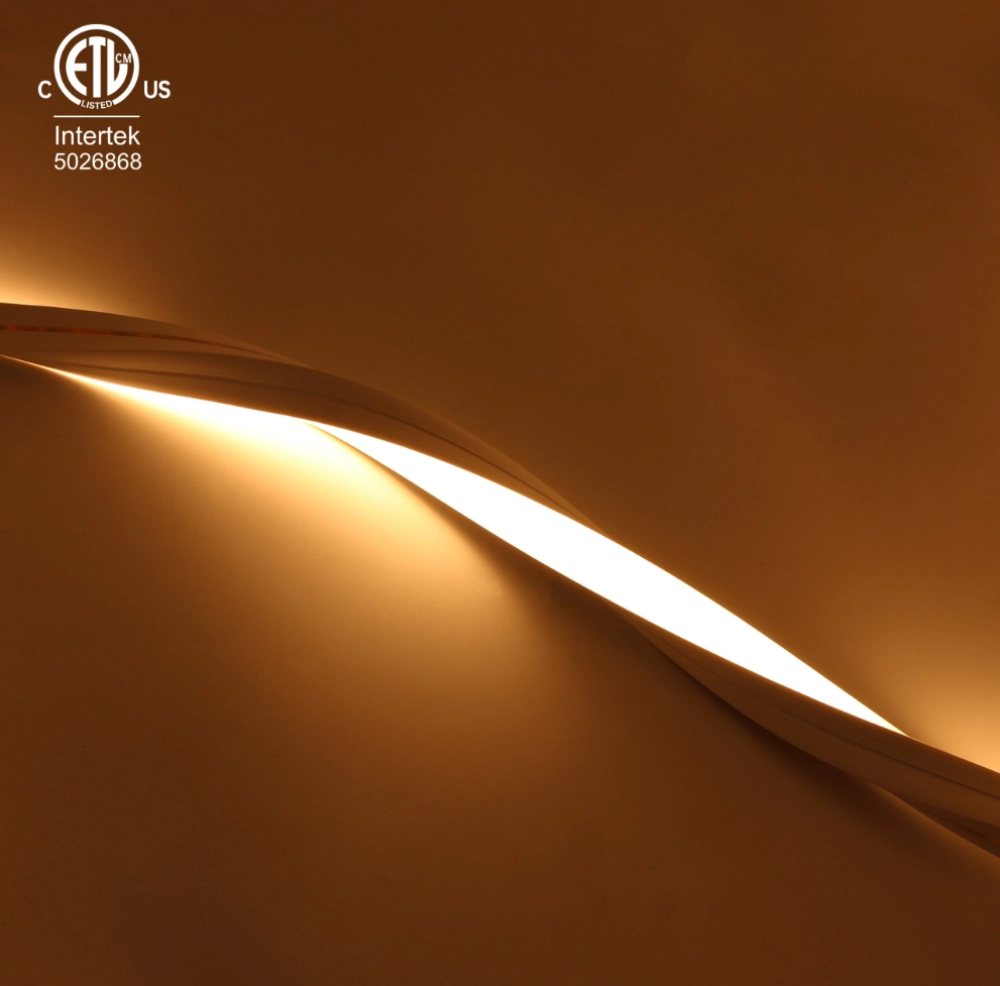
Raymates’ Multi-glowing Neon Light range supports 120°, 270°, and 360° light output.
A wall-mounted logo mainly viewed from the front may not need a 360° structure. A 360-degree LED neon flex design can benefit suspended signs, freestanding graphics, and sculptural installations viewed from several directions.
The 360° version uses back-to-back LED strips to distribute light around the profile. This gives designers another option when standard front-facing led neon flex cannot provide the required visual effect.
Glass Neon Works Best When Hand-Crafted Tube Character Is the Priority
Traditional glass neon has a visual quality that comes from the visible tube itself. Small differences in bends and tube form can be part of the design rather than a defect.
That makes glass suitable for one-off artistic projects.
For retail chains or standardized branded environments, however, custom neon signage often needs repeatable curves, consistent mounting, and predictable electrical layouts. Flexible LED products are easier to reproduce across several locations.
What Should You Confirm Before Ordering LED Neon Flex for Outdoor Signage?
A supplier needs more than a logo file. The project drawing should show the physical size, bend direction, viewing angle, power arrangement, installation surface, and environmental requirements.
Confirm Size, Bend Direction, Voltage, Power, Waterproofing, and Mounting
Before ordering, confirm:
- Overall dimensions
- Letter and logo geometry
- Bend direction
- Required viewing angle
- Indoor or outdoor installation
- Waterproofing requirement
- Voltage and total power
- Color or CCT
- Mounting profile or clips
- Driver location
- Cable entry and termination points
For commercial neon signs, these details reduce the amount of improvisation required on site.
Use Drawings and Samples to Prevent Rework
Drawings should show where curves start, where cables leave the sign, and where power is injected. A sample can then confirm the bend, luminous direction, mounting fit, and joint appearance before batch production.
Raymates can confirm project details through email or video communication and provide project drawings and installation drawings as part of its project support process.
For large orders, this stage is especially useful because one incorrect bend direction or hidden cable problem can be repeated across every unit if it is not found before production.
Raymates Custom Service Supports Project-Specific Sign Designs
Raymates’ customization service covers special color temperatures, strip lengths, logo customization, private molds, voltage, power, and packaging.
Top Bend Neon Light is relevant when the sign geometry matches its bend direction. Multi-glowing Neon Light is more suitable when the project needs 120°, 270°, or 360° viewing.
The product should follow the drawing, not the other way around. That is the safer approach for irregular lettering, suspended pieces, curved exterior branding, and other custom outdoor installations.
Conclusion
For retail stores, restaurants, offices, hotels, and most other commercial environments, LED Neon Flex usually offers the lower-risk route. It reduces handling concerns associated with rigid glass, supports low-voltage electrical layouts, and can be planned around accessible drivers, mounting hardware, waterproof terminations, and repeatable fabrication.
Glass neon still deserves consideration where authentic hand-bent tube character is the main design goal.
The better choice depends on six practical factors: durability, electrical safety, operating cost, installation, design flexibility, and the required visual effect.
If your project includes tight curves, exposed cable joints, unusual viewing angles, long illuminated runs, or uncertain power-feed locations, send the drawing and installation requirements before production. Raymates can review these details through its contact channel so the bend direction, voltage, waterproofing, mounting hardware, and customization requirements can be clarified before the order is finalized.
FAQ
Is LED Neon Flex Suitable for Permanent Outdoor Signs?
Yes, if the selected product has suitable environmental protection and the installation is sealed correctly. LED Neon Flex with IP-rated silicone construction can be used outdoors, but cable entries, connectors, end caps, driver locations, and drainage around the sign still need proper planning. An IP rating cannot compensate for an unsealed field connection.
Is Glass Neon Brighter Than LED Neon for Commercial Signage?
Not necessarily. Brightness depends on color, power, tube or strip structure, diffuser design, sign geometry, and viewing distance. Buyers should compare the required visibility, total installed wattage, and maintenance burden rather than assume that either technology is always brighter.
How Do I Choose Between 120°, 270°, and 360° Neon Light?
Start with the viewing direction. A wall sign seen mainly from the front may only need front-facing light. Suspended or freestanding signs can benefit from wider illumination. Raymates’ Multi-glowing Neon Light provides 120°, 270°, and 360° options, so the sign geometry should determine which structure is suitable.