Choosing one large LED driver or several smaller power supplies is not only a wattage decision. The layout affects voltage drop, dimming, service access, and failure impact. A compact display may work well from one centralized supply, while a long retail shelf or multi-room installation often needs local power units.
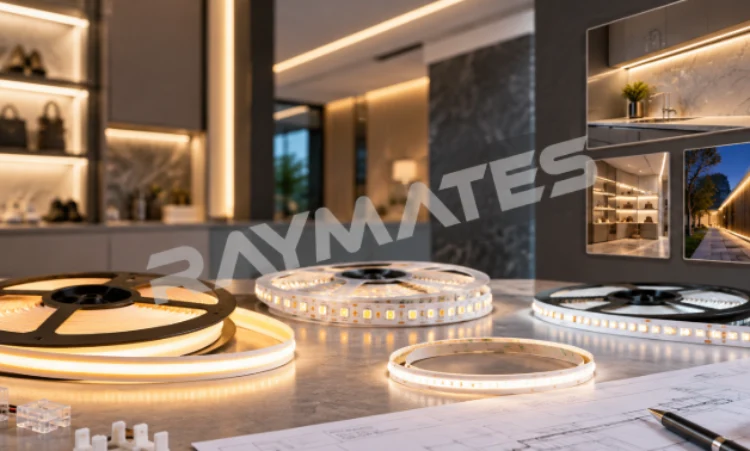
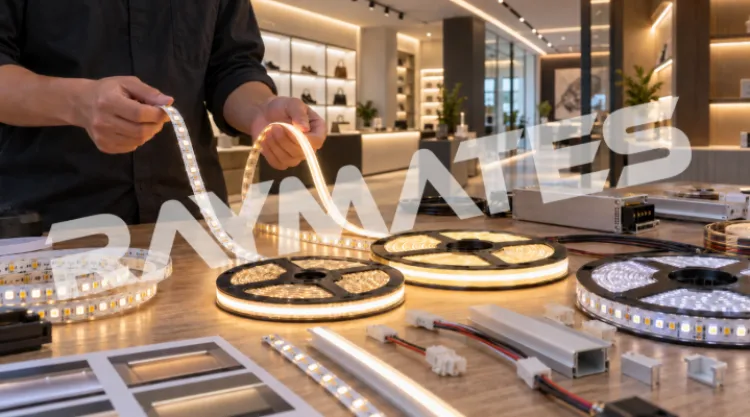
Raymates manufactures LED strips, LED Sheet products, controllers, connectors, drivers, and related installation accessories. Its low-voltage range covers 3V, 5V, 12V, 24V, 36V, and 48V for different products and wiring plans. The useful starting point is the real load and installation drawing, not the largest power rating available.
What Should You Confirm Before Comparing Driver Layouts?
Before comparing centralized and distributed power, confirm the electrical limits of the project. A larger supply cannot correct the wrong voltage, poor cable routing, or an incompatible control system.
Match the Output Voltage to the Lighting Load
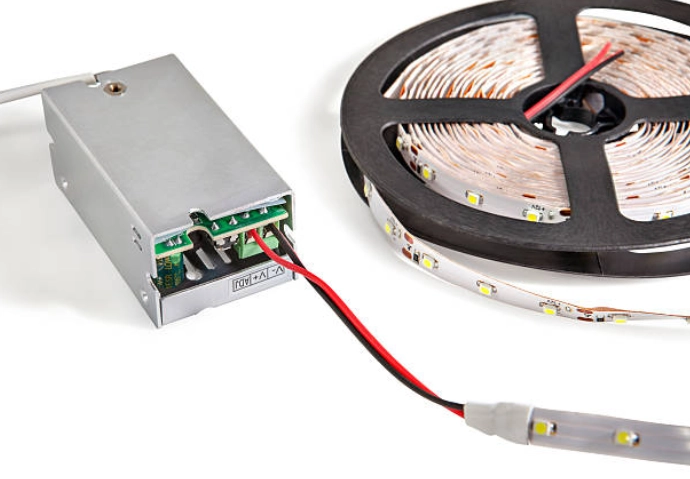
The output voltage must match the lighting product. A 24V strip requires a 24V supply, and mixed-voltage products should not share one output circuit. For common strip-lighting systems, a constant voltage LED driver is normally paired with a product designed for that fixed voltage. The strip label, controller input, and wiring diagram should show the same rating.
Calculate the Connected Load Before Selecting Capacity
LED strip power supply sizing starts with total connected wattage. Multiply wattage per meter by installed length, then include any modules powered from the same unit. The selected supply should also have operating headroom.
For example, 10 meters of strip rated at 15W per meter creates a 150W connected load. Final selection should also consider cable length and thermal conditions.
Check Dimming, Control, and Installation Conditions
PWM, 0–10V, DALI, DMX, SPI, Wi-Fi, and Zigbee systems do not all use the same control path. These parts must be checked as one system.
The mounting environment also matters. A ventilated cabinet differs from a sealed ceiling void or the cavity behind backlit stone. Outdoor work may require a waterproof LED power supply for outdoor lighting, sealed cable entries, drainage, and replacement access.
When Is One Large LED Driver the Better Choice?
Centralized power works best when lighting runs are close together, use the same voltage, and operate as one zone. In that setting, one large LED driver can reduce component count and simplify the incoming AC side.
Centralized Power for One Compact Lighting Zone
Compact hotel features, display walls, bar counters, and grouped cabinets can often share one supply when branch cables remain short. Raymates has used a centralized 24VDC supply with natural white COB strip lighting in a hotel project. It suited one compact feature, not every project.
Lower Hardware Count and Simpler Purchasing
One larger unit means fewer AC inputs, mounting points, and spare models. Purchasing is also easier when the project uses one voltage, one control method, and one lighting type.
The saving is not automatic. A larger unit may need thicker branch cables, a larger enclosure, protected distribution terminals, and more careful heat management.
Single-Point Failure and Long-Cable Risks
If the central unit stops, every connected branch may go dark. That may be acceptable for a decorative wall but less suitable for a retail counter or hotel corridor.
Long output cables also increase voltage drop in long LED strip installations. Typical signs are dimmer output at the far end, uneven brightness, or color shift. Larger conductors, power injection, shorter branches, or local supplies may be required.
When Do Several Smaller Power Supplies Work Better?
Distributed power is useful when lighting is spread across separate areas, when zones need independent control, or when partial operation must continue after one failure.
Distributed Power for Long or Separated Runs
Long shelves, display islands, multi-room features, and large architectural details often benefit from local power points. Each supply serves a defined section with shorter output cables, which can reduce voltage loss and simplify balancing.
The tradeoff is more AC wiring and more service points.
Independent Zones for LED Sheet Installations
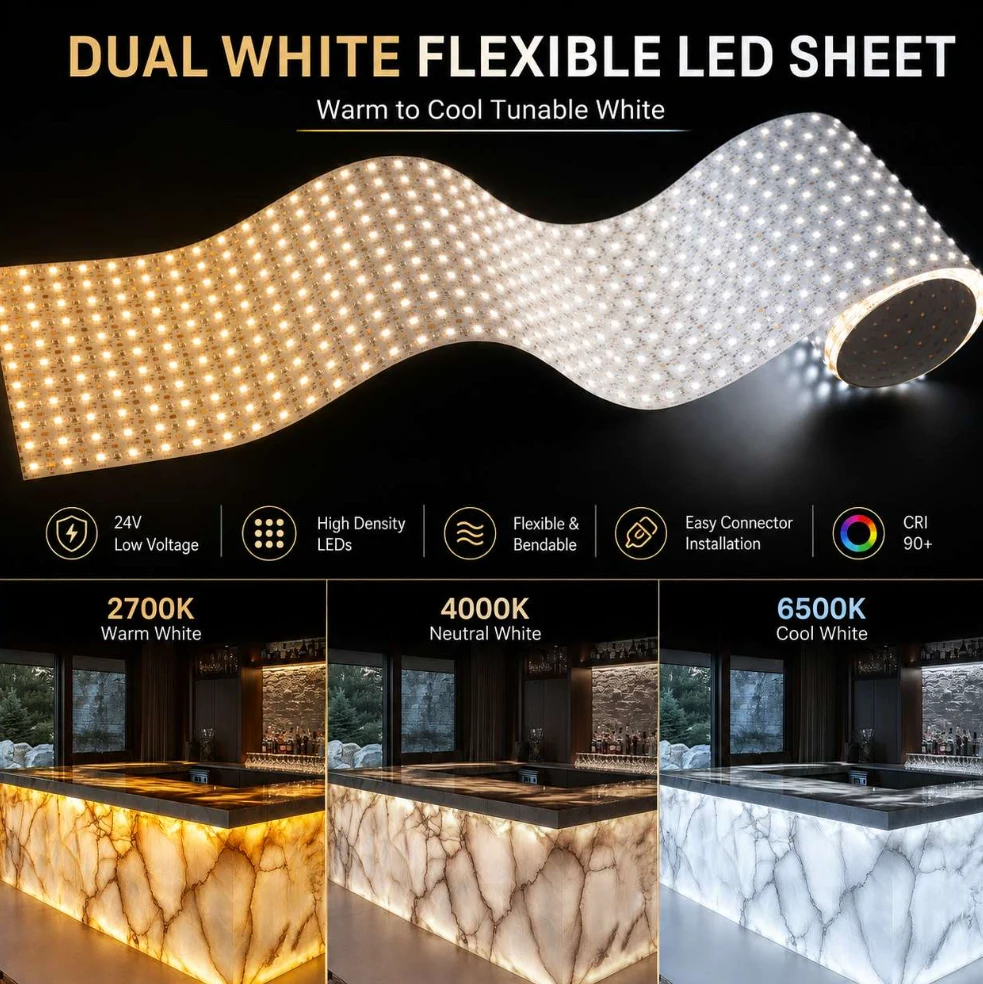
Raymates LED Sheet is used for cosmetics counters, hotel features, backlit bar countertops, onyx and marble surfaces, and display lightboxes. These projects are often modular rather than one continuous line.
Separate supplies suit sections that need independent switching, dimming, or service access. One centralized unit can still work for a compact panel operated as a single zone.
Easier Fault Isolation and Future Expansion
With several smaller units, one failure normally affects only one section. Teams can test one zone without shutting down the complete installation, and later expansion is easier.
More units also mean more terminals and possible loose connections. Clear labeling, repeatable wiring, and consistent supply models reduce this risk.
How Should the Layout Change for COB LED Strip and LED Sheet Projects?
The physical form of the product should guide the power plan. Linear strip lighting and sheet backlighting distribute load differently, even when they use the same nominal voltage.
COB LED Strip for Continuous Linear Lighting
Raymates COB LED STRIP suits ceiling grooves, shelves, cabinets, hotel details, and display structures where a continuous luminous line is needed. COB construction reduces visible point effects.
One supply may suit a short, compact run. Several local units are usually easier to manage across long or separated lines. Buyers should confirm voltage, wattage per meter, total length, cutting interval, dimming method, cable distance, and aluminum profile requirements before ordering.
LED Sheet for Modular Backlighting
LED Sheet can be cut and fitted around curved or irregular surfaces. Raymates materials specify sheet thickness from 1 to 3mm, LED spacing of about 20mm, CRI of at least 90, and rated life of at least 50,000 hours under L70 conditions.
It is useful where a strip could leave visible lines behind translucent material. Power planning should follow the modules and control zones. One supply may suit a compact lightbox, while several smaller units are often more practical for a long counter or multiple stone panels.
Driver Placement That Protects Light Uniformity
Power equipment should remain accessible without casting shadows behind translucent surfaces. Drivers and controllers should not be pressed against heat-sensitive diffusers or sealed into spaces without airflow.
A pre-production test should use the real surface material, final cable length, connectors, dimming equipment, and mounting method. This can reveal cable loss, connection heat, or control noise before installation.
How Can Buyers Reduce Lifetime Cost and Finalize the Driver Plan?
The lowest purchase price does not always produce the lowest project cost. Buyers should compare wiring labor, replacement access, spare parts, and downtime.
Compare Total Installed Cost Instead of Driver Price
One centralized supply can reduce hardware count but may require larger cables and a more complex distribution point. Several smaller supplies can shorten low-voltage runs but increase AC wiring and service locations.
| Project Condition | One Large Supply | Several Smaller Supplies |
|---|---|---|
| Compact single zone | Usually practical | Often unnecessary |
| Long separated runs | Higher cable-loss risk | Better local placement |
| Independent dimming | More complex | Easier zone separation |
| Failure impact | Whole area may switch off | One section is usually affected |
| Future expansion | May require redesign | Easier to add a section |
Verify Safety, Compatibility, and Batch Consistency
Before bulk ordering, confirm input voltage, output voltage, rated wattage, dimming protocol, environmental protection, and destination-market certification. Raymates applies ISO9001 management, holds UL, ETL, CE, RoHS, and TUV certifications, and carries out inspection before shipment.
Test startup, full-load operation, dimming range, flicker, temperature rise, audible noise, and brightness consistency with the actual strip or sheet. An LED driver should not be approved only as a separate component.
Contact Raymates for Project Matching and After-Sales Support
Prepare the project drawing, total strip length or sheet area, voltage, wattage, cable distance, number of zones, dimming method, installation environment, and destination market. Raymates can review the lighting product together with drivers, controllers, connectors, profiles, and mounting accessories. Project drawings, installation guidance, OEM/ODM work, and technical support can be discussed through the contact channel.
FAQ
Q: Can one LED driver power several LED strip runs?
A: Yes, if every run uses the same voltage and the combined wattage stays within the selected capacity. Branch cable length and voltage drop must also be checked.
Q: Is one large power supply more efficient than several small units?
A: Not always. A large unit reduces hardware count, but long output cables may add losses and installation cost. Local supplies often suit distant or independently controlled sections better.
Q: How do I choose between centralized and distributed power for COB strip or LED Sheet?
A: Use centralized power for a compact, single-control zone with short cable runs. Use distributed power for long distances, separate dimming zones, modular backlighting, or projects where one failure should not stop the whole installation. The final LED driver layout should be checked against the real load, cable distance, and control system.