The same lighting project might include a glass display case, several cabinets and a ceiling cove. A COB LED strip is an option for all three, but each has a different constraint. In the display case, glass can reflect the source. In the cabinet, the strip has to fit around hinges and shelf supports. The cove may run for several metres and need a serviceable driver location.
Before asking for a quote, mark each fixture’s dimensions and viewing angle. Show which surfaces need light and where a wire can exit. These details help the supplier select a strip, profile and connection for each part of the project.
Start with the fixture, not the reel
Mark each strip’s start, end and connection on the fixture layout drawing. A line that looks continuous may need more than one feed. Measure the available mounting width and the distance to the surface being lit. Where the design uses a lens, include it in the space allowance.
Include glass or polished finishes in the mock-up when the final fixture uses them. They may reflect even a closely spaced COB source. Sampling gives the installer an opportunity to adjust the strip position before assembling the cabinet frames.
Display shelving: illuminate objects without glare
A strip mounted under a shelf’s front edge can light the objects below. The exact position takes some testing. Moving it towards a glass door may strengthen reflections; moving it back may leave the front of the display in shadow. Where the fixture allows, keep the source out of the viewer’s direct line of sight.
Before approving the colour, place the intended exhibits or decorative objects on the shelf. Their surface textures, the shelf finish and the surrounding ambient lighting all affect the result. Compare samples in the finished fixture and record the designer’s selection.
The Hot Selling COB Strip is one candidate for illuminated display shelving. One configuration uses a high-density design on an 8 mm board, with cutting units of 25 mm at 12V and 50 mm at 24V. Request the intended colour and voltage with its drawing and sample, then check how the PCB and connector fit the fixture.
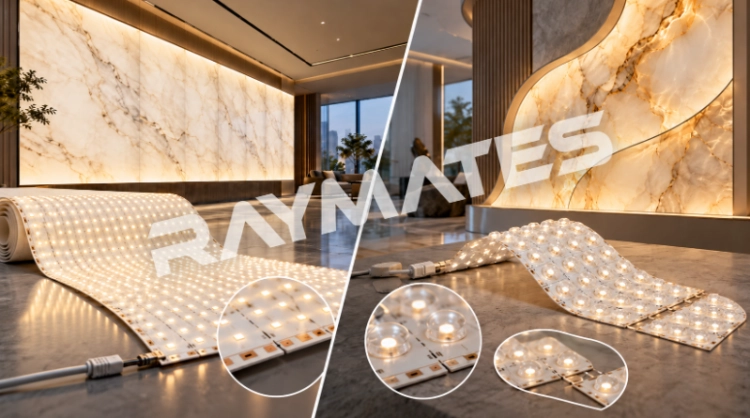
Not every display calls for a line of light. A translucent counter may need illumination over an area. Raymates also offers a Matrix LED Sheet for backlighting applications. One bar-counter installation used a warm-white flexible LED sheet beneath marble; the sheet was cut and folded to suit the counter. For a new marble counter, test the stone and the proposed sheet together before deciding on spacing and output.
Cabinets: make room for shelves, doors and service
Cabinet orders often use short sections. If the opening measures 600 mm, the lit portion may be shorter: the connector and cable exit need room, and the strip can only be cut at its marked points. Allow for hinges and shelf supports too.
On a glass cabinet, check reflections in the door and shelves. In an opaque cupboard, open the door and look at the contents. A home wardrobe may use a warmer colour than an exhibition cabinet; compare the options with the room finishes before deciding.
The Mini Size COB Strip is an option for compact installations. Its standard board is 3 mm wide. Check the frame for the cable and connector as well, and build the sample with the intended channel and diffuser.
Architectural details: plan the line through corners
Consider what the cove looks like from the corridor and from a seated guest’s position. Is the intention to see a line of light, wash the wall or light the ceiling indirectly? Mark the start, finish and corners on the drawing. If it only shows the middle of the run, the installer still has to solve the ends on site.
Compare the plan with the Super Long COB Strip where the design calls for long runs. Confirm the permitted length and feed arrangement for the version being ordered, and make sure the driver remains accessible. At corners, follow the product’s cutting and bending instructions instead of forcing it around the profile.
A hotel decorative-lighting project used Raymates natural-white COB strips with a 24V DC supply and a 240W driver. That is one project’s configuration. For another cove, calculate the strip length and load and plan the wiring before choosing the driver.
Coordinate cuts and wiring across different fixtures
Mark the cutting positions and cable exits, including the route to each power supply. Short cabinet pieces may need their leads attached before the unit is assembled. The cove may have a different route altogether, even when its colour is meant to match the cabinets.
Make repeated cabinet modules easy to assemble
For each cabinet module, check whether the strip can be supplied at the required length and how its connector fits in the frame. A short cutting interval can reduce the dark space at the end, provided that interval is available for the selected model. Cutting between the marked points risks damaging the circuit.
Think about assembly and service too. A removable shelf should not trap its own wire. If a project has many identical cabinets, the installer benefits from consistent connector orientation. The driver should still be reachable after the fit-out.
Raymates supplies power supplies, controllers, connectors and aluminium channels alongside its COB strips. For a custom cabinet, send the module dimensions and connection requirements with the inquiry. The engineering team can review the application and prepare project or installation drawings.
For an order with several cabinet sizes, include a cutting and connection schedule for each one. Raymates offers product and power customization. PCB widths across the broader range run from 3 mm to 30 mm, with low-voltage options from 3V to 48V. Confirm the combination available for the selected COB model before approving the sample.
Splitters, extension cables and mounting clips are also available from Raymates. They matter when several short shelves share a driver. Show where the wiring splits and whether a connector must pass through an opening, then include those dimensions with the sample request. The project team can use the application requirements to prepare a customized solution.
For repeat orders, send the approved drawing and part numbers for each cabinet size. Raymates offers OEM production and ODM design and production services; the quotation should confirm leads, packaging and delivery terms.
Separate long-run design from short-run design
For a longer run, 24V is one option to consider. Check the selected strip’s permitted length and calculate the driver load. Cable length, conductor size and feed position matter as well. A strip can be within its maximum run length and still have an overloaded driver or an undersized cable.
For example, four metres at 10 W/m have a calculated load of 40 W. A 40 W driver leaves no spare capacity on that calculation. Select a driver using its manufacturer’s loading guidance, the controls and supply conditions. Divide the run or add feeds where required by the strip instructions and voltage-drop calculation.
The number of connections can become the main wiring issue in a display with many short shelves. On a cove, the concern may be how to reach a driver above a finished ceiling and keep adjacent sections visually consistent. Ask for a layout for each area instead of copying the same feed arrangement across the job.
Review a sample in each real application
For a mixed project, a strip on its own is not enough to approve the installation. Put one sample into a cabinet or shelf and another into a short section of the architectural detail. Use the intended channel, cover, adhesive and power supply. If glass or polished metal sits next to the light in the final fixture, include it in the test.
Compare colour, output and reflections
Place the intended objects in the display, then view the shelf from a typical visitor’s position. If comparing two strips, use the same dimming setting and the same ambient lighting. Look at the illuminated objects as well as the light line: a high CRI LED strip still needs a suitable colour temperature and enough light on the display.
On the cove, inspect the joins and corners. Open the cabinet door and check the back of the shelf. Photograph each approved sample, recording its model, colour, controller and cover. The purchasing team can then match each reference to the correct fixture.
Check the environment and service access
Will the counter be washed down, or will the fixture stay dry? If moisture can reach the light, specify protection for the installed assembly. Check the strip’s rating along with how its cut ends, connectors and cable entries will be sealed.
The strip also needs somewhere to mount. Raymates offers an aluminum profile range; compare the inside dimensions and available cover with the chosen PCB. Leave a practical route to drivers and connections for later maintenance.
Prepare one purchasing brief for the whole project
For a wholesale COB LED light strip quotation, split the request into display shelving, cabinets and architectural runs. Give the number of fixtures and usable dimensions for each. Add the target colour and output, voltage, controls, mounting surface, protection requirement and connector position. A marked-up drawing or photograph will help clarify a complicated installation.
Tell the supplier which areas need to match visually. The compact cabinet strip and longer cove strip may have different construction, so compare their samples before signing off the colour and controls. Keep the approved part numbers with the order; they will be useful again when replacement lengths are needed.
FAQ
Can the same COB strip be used in display shelving and cabinets?
Sometimes, if the dimensions and specifications suit both fixtures. Check the width, cut interval, output, protection and wiring. A compact cabinet may need a different board or connector from a long shelf.
Is COB strip suitable for architectural lighting as well as display shelving?
Yes. Mounting positions and run lengths may differ, so approve a representative sample for each use.
What should buyers send with a project inquiry?
Send drawings and quantities with the lit lengths and available profile space marked. Include the target colour, output, voltage, controls, environment and delivery requirements. A photo can show how the strip needs to fit in the cabinet or display.