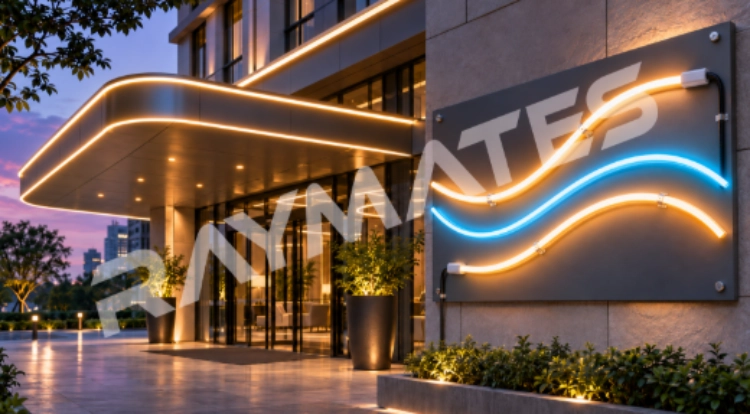
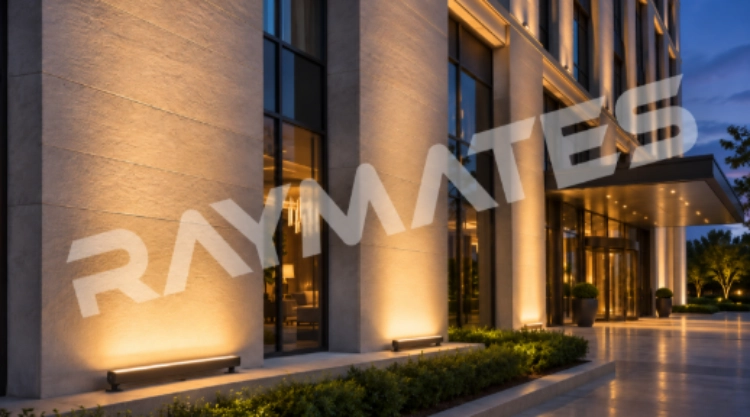
LED neon flex is an LED strip inside a flexible, diffusing body. Silicone and PVC are common housing materials. Seen from outside, the LEDs produce a line of light through that body. It can form a letter on an entrance sign or follow an architectural edge, provided the selected product suits the shape and installation.
Suppose a hotel drawing includes a name above the door and an outline along the roof. The sign maker is concerned with short strokes and small curves. The facade contractor has to fix longer lengths to the building and find a route back to the power supply. Split those requirements in the inquiry. There is no reason to assume both should be made from the same reel type simply because the rendering uses the same colour.
What is inside an LED neon flex system?
The LED circuit is inside the flexible body. The driver, supports and connections are still separate parts of the installation. A sign maker may mount the neon on a backing panel, while a facade contractor may be fixing it to metal trim or a track in a concrete recess. Include those parts when comparing quotations. A price per metre of neon doesn’t cover the finished assembly.
Each product has a permitted bend direction and minimum radius. Check both on its drawing. A piece that bends easily in one direction can still be damaged if twisted to reach the next stroke of a letter.
The glowing face changes the appearance
Look at an unmounted sample from the front, side and back. Where only one face is meant to glow, the other faces will not give the same effect. That may be fine for a wall-mounted name. For a suspended feature viewed from the staircase as well as the lobby floor, it needs a closer look.
Raymates offers a Multi-glowing Neon Light range with different luminous formats. If the brief calls for 360 degree LED neon flex, show the supplier where people will see it and where the fixing hardware will sit. The cable has to leave somewhere too. Confirm the bend drawing separately; light output around the body does not establish how that body may be bent.
The housing is part of the dimensions
Ask for the outside dimensions of the finished neon. Those are the dimensions needed by whoever is cutting a groove or selecting clips. The circuit width inside the housing cannot settle that fit, and the connection at the end may need its own allowance.
Try the end assembly in the tightest part of a small hotel room sign. Check the space beside the next letter and behind the backing. On a canopy, put it against the intended trim. Making this check with a connected sample is worthwhile before the metalwork is cut: the straight piece may fit perfectly while the termination prevents it from sitting in place.
Use the sign artwork to choose the light
Put dimensions on the artwork for an LED neon flex sign. A PDF of a logo may have no reliable scale once it reaches the workshop. The sign maker needs the actual letter height and spacing, the stroke width and the smallest curve. Include any return behind the backing panel in that drawing.
The fabricator needs to know where a lit stroke finishes and where an unlit cable takes over. Some lettering can be made from separate sections without changing how it reads; other designs show every break. Decide that on the drawing before ordering cut lengths.
Check a difficult letter first
The straight part of a word tells little about whether the product fits its tightest curve. Make the sample from the awkward letter or the smallest loop. Include the intended backing, clips and wire exit. View it at the distance expected in the finished lobby or outside the entrance.
Raymates has separate Top Bend Neon Light and Side Bend Neon Light families. Ask for a cross-section and bend illustration with the proposed part number. Then lay that information beside the lettering. The workshop should be able to trace the curve without turning the neon onto a face that ought to be visible.
A return out of the sign plane needs its own detail. It might require a connection, or a product made for that movement. Forcing a twist into the sample won’t resolve the specification. With the power off, check that the piece still sits properly in the chosen clips and does not have to be held against them under strain.
Plan where the cables disappear
A front view can hide a wiring problem. Add a side view showing the backing thickness and the route to the driver. Where several letters have separate feeds, identify each cable and its connection point behind the sign.
How will a technician reach a failed connection? On a stone entrance wall, removing the whole sign may involve access equipment and disruption to the entrance. Agree which cover or section can be removed, and leave that route clear. It is much easier to move a fixing on a drawing than after the stone has been drilled.
Architectural outlines need their own specification
On an elevation, a canopy outline can be drawn with a single stroke. On site, the route may cross an access panel or a building joint. Put those interruptions on the lighting drawing and agree how each will be handled. A neat line on the front elevation does not show whether a panel can still be opened after the light is installed.
Building exteriors, signs and railing outlines are among Raymates’ LED neon applications. The company also provides project and installation drawing support. Send a marked elevation for a facade neon lighting project, with the fixing areas and cable routes shown. The overall length is useful for a budget; the individual sections are needed to work out what to supply.
Order by installation section
An LED neon flex roll is a supply format, not a promise that its whole length can operate from one feed. Confirm the permitted run length, connection method and power arrangement for the selected configuration. Factory preparation may be worth discussing where difficult access makes field cutting and sealing impractical.
Mark removable sections on the canopy drawing. Several bays may look identical from below but have their cable entries at different ends. Labels on the supplied pieces should match the bay references. A technician ordering a replacement can then use that reference and the part number instead of lifting adjacent lengths to find out how the run was connected.
Review the line from ground level
Stand where the finished line will normally be seen. For a roof edge, that may be the pavement on the other side of the approach road. Include a corner or join in the trial section, with the intended trim fitted. A photograph taken beside the sample is useful for workmanship, but it answers a different question from the distant view.
At a hotel entrance, test after dark with the entrance and sign lights operating. Read the name from the approach, then look at the outline from near the door. Reduce the output if it is uncomfortable or distracts from the sign. Once the designer accepts the effect, record the dimming setting with the sample details for commissioning.
Specify power, controls and outdoor connections together
Choose the supply to match the selected product’s voltage and calculated load. Include the actual cable route in the electrical review. A driver beside a sign and a driver in a distant plant cupboard impose different cable requirements.
A dimming test needs the proposed controller as well as the light and supply. Driver and control compatibility affects the result. Run the sample at the low setting intended for evening use, then at full output. Keep the part numbers from that test together, so a purchasing substitution doesn’t silently change the combination being ordered.
Outdoor protection includes the ends
Outdoor LED neon flex needs a protection arrangement suited to its location. Rain on a canopy edge, cleaning water and an installation near standing water are different conditions. Describe the exposure to the supplier and confirm the rating of the assembled sections, including connectors and cut ends.
Do not transfer a housing’s rating to a field-made joint without checking the approved termination method. Show the cable entry and any drainage provision in the detail sent for review. On an exposed building edge, give the supplier the expected temperatures and sun exposure too; indoor sample approval does not establish suitability for that location.
Prepare a project inquiry that can be quoted
Raymates offers OEM production and ODM design and production services. When requesting custom LED neon flex for architectural projects, put the current drawing revision on the inquiry. Separate the sign pieces from the building-outline lengths, even if they have the same colour. Assign references that the supplier can carry through to the packaging.
Include the luminous direction, colour, dimensions, quantities and proposed power arrangement. Ask for the matching supports, connectors and end treatment in the quotation. A quote for the light alone leaves the site team to discover which small parts were omitted.
Keep the accepted sample after the order is placed. Store its part number and drawing revision with it, so there is something to compare against the first production pieces. If the architect later moves a cable exit or changes a curve, return that detail for review before the rest is made. The change may be small on paper and still require a different connection at the workshop.