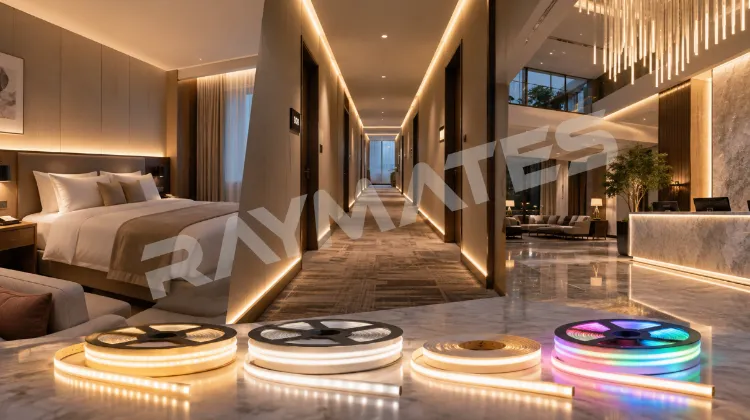
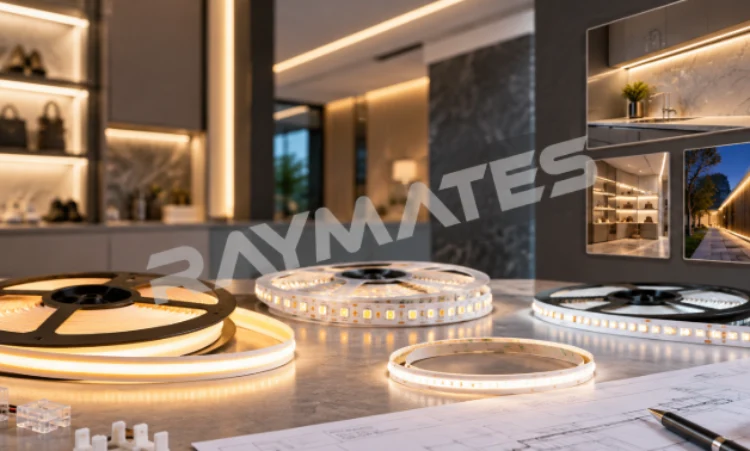
Choosing LED strip lighting for a hotel project starts with the space, not the strip. Guest rooms need comfortable and controllable light, corridors need consistent output across longer runs, and lobbies need clean architectural lighting without limiting the designer’s ability to create visual accents. A useful specification should therefore define light quality, voltage, control, installation space, and maintenance access before the final model is approved.
Raymates supplies LED strip and COB strip solutions for commercial lighting projects, with multiple voltage options, board widths, accessories, and customization support. For hotel lighting projects, this allows different zones to use different specifications instead of forcing one hotel-wide setup.
What Should Hotel Buyers Specify before Choosing LED Strip Lights?
A hotel lighting schedule should separate visual requirements from electrical and installation requirements. The LED strip, driver, controller, profile, and wiring method form one system. Selecting the strip first and solving everything else later often creates problems at the installation stage.
Lighting Quality before Wattage
Wattage alone does not tell a buyer whether a strip will look right in a hotel. Color temperature, CRI, visible LED points, color consistency, and viewing angle all affect the finished space.
COB strip construction is useful where a continuous light line is required because it reduces the visible dotting associated with more widely spaced LED sources. Raymates COB configurations can provide a seamless lighting effect, a beam angle of up to 180°, and CRI values of 90 or above.
For guest-facing areas, Hot Selling COB Strip is a practical starting point. It is available in 12V and 24V configurations, with CRI above 90 and a 180° beam angle. These characteristics suit applications where the strip sits close to reflective walls, ceilings, furniture, or decorative finishes.
Voltage, IP Rating, and Dimming by Zone
Voltage should be selected together with run length and wiring layout rather than treated as a fixed hotel standard. Raymates offers low-voltage options including 12V, 24V, 36V, and 48V, which gives project teams more flexibility when planning short decorative runs or longer architectural lighting sections.
IP rating should also follow the actual environment. A dry guest-room cove does not need the same protection as lighting near bathrooms, spa areas, or semi-exposed spaces. Depending on the application, LED strip configurations may use IP20, IP65, or IP67 protection.
Dimming requires the same level of coordination. PWM and 0–10V dimming are useful options, but the strip, driver, and control system must be compatible before the project reaches site installation.
Installation Components and Maintenance Planning
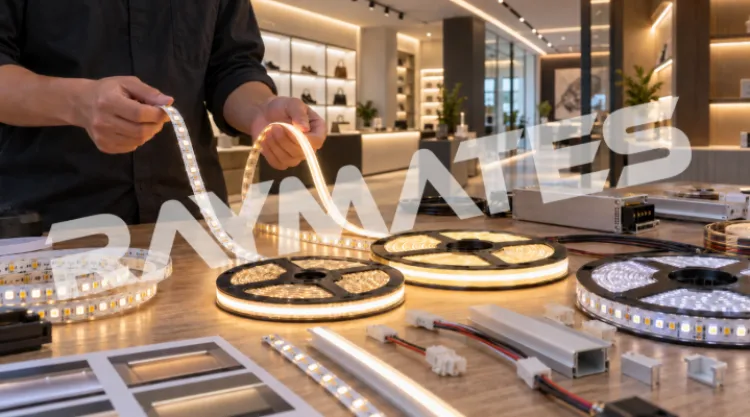
The strip is only one part of the installation. Power supplies, controllers, connectors, extension cables, aluminum channels, mounting clips, and end caps affect both installation quality and future service work.
For wholesale LED strip for projects with many repeated rooms, standardizing these components can reduce unnecessary variation. If every room uses different connectors, drivers, and channel sizes, replacement work becomes harder even when the LED strips themselves are similar.
Hotel buyers should also confirm where drivers remain accessible after ceilings, wall panels, or furniture are completed.
How Should LED Strip Lighting Be Specified for Guest Rooms?
Guest rooms place lighting close to occupants, fabrics, furniture, mirrors, and wall finishes. The goal is usually not maximum brightness. Comfortable light, low glare, concealed installation, and predictable dimming matter more.
Warm, Dot-Free Light for Bedside and Cove Lighting
Headboards, ceiling coves, TV walls, and bedside details are common positions for guest-room LED strip lighting. These areas can expose individual LED points if the strip is mounted too close to the diffuser or directly within the guest’s line of sight.
A COB LED strip for hotel lighting can help create a more continuous line. Warm white around 3000K is suitable for many relaxation areas, while a more neutral white may work better around desks or task zones.
The Hot Selling COB Strip can be used for these applications where its voltage, CCT, output, and dimensions match the room design. The strip should still be installed with enough recess depth or diffusion to prevent direct glare from the bed.
Compact Profiles for Furniture and Narrow Details
Hotel furniture often creates tighter installation spaces than ceiling coves. Wardrobes, shelving, bedside joinery, mirror surrounds, and decorative grooves may not accommodate a standard-width PCB.
Raymates’ Mini Size COB Strip is designed for compact installation, with ultra-slim widths around 3–5 mm. This makes it easier to integrate lighting into furniture or narrow architectural details while retaining the continuous COB appearance.
The groove width should not be the only dimension confirmed. Buyers should also check cutting position, cable exit direction, connector clearance, and the space required for the aluminum profile or diffuser.
Dimming and Color Temperature for Guest Comfort
A guest room may require different lighting levels for entry, reading, resting, and night use. For guest-room LED strip lighting, the strip, driver, and dimming method should therefore be specified as one circuit rather than purchased separately.
Raymates LED strip configurations can work with PWM or 0–10V dimming systems, while color temperature options can cover warm through cooler white light.
The important purchasing point is consistency. A hotel may install the same lighting detail across dozens or hundreds of rooms, so noticeable differences in CCT or dimming behavior between rooms become much more visible than they would in a single residential installation.
What Changes When Specifying LED Strip Lighting for Corridors?
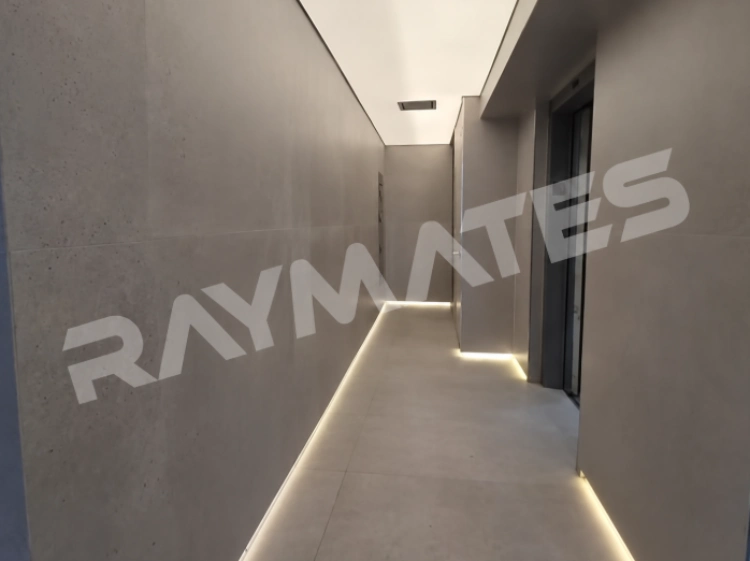
Corridors change the engineering priorities. Runs are often longer, the lighting repeats continuously, and access for maintenance may be limited. Voltage drop, feed points, brightness consistency, and driver locations therefore become more important.
Long Runs and Voltage-Drop Control
Hotel corridor LED strip lighting should be planned from the full installed length rather than from a short sample. Longer circuits can suffer visible brightness reduction if the voltage, conductor size, feed points, and load are not coordinated.
Raymates’ Super Long COB Strip is intended for extended installations. A standard configuration uses DC24V, 480 LEDs/m, 10W/m, a 10 mm board width, and a 20 m roll.
This type of long LED light strip can reduce the need to break a continuous architectural line into many short sections. It does not remove the need for electrical planning, however. The installer still needs to calculate the actual run, driver capacity, cable length, and feed arrangement.
Uniformity and Thermal Management along the Corridor
Long corridors make small variations easier to notice. If one section is brighter, warmer, or cooler than the next, the difference repeats through the whole space.
A corridor specification should therefore include light uniformity, color consistency, thermal management, and aluminum profile selection. Aluminum channels protect the strip mechanically while also helping transfer heat away from the PCB.
For a 24V COB LED strip installed over a long corridor, a representative test section should use the intended driver, channel, cable length, and installation method. A short strip powered on a workbench does not reveal every issue that may appear in the completed corridor.
Fewer Connections with Accessible Maintenance Points
Reducing connection points can simplify installation, but service access should not disappear with them.
Super Long COB Strip can help create longer continuous sections with fewer unnecessary breaks. The project team should still identify where drivers, connectors, and replaceable sections can be reached after handover.
This is especially important in hotel corridors because maintenance work often needs to be completed without opening large areas of finished ceiling or wall paneling.
How Should Lobby Lighting Balance Uniformity and Visual Impact?
A lobby serves several functions at once: reception, circulation, waiting, architectural presentation, and sometimes events or lounge activity. White architectural lighting and decorative color lighting should therefore be treated as separate layers.
High-CRI White COB for Reception and Architectural Lines
Reception counters, wall lines, ceiling coves, and decorative panels benefit from clean white light and consistent color rendering.
High-CRI COB lighting helps preserve the appearance of stone, timber, fabrics, and decorative surfaces. A continuous light line also works well where the source may be visible through a shallow cove or diffuser.
Hot Selling COB Strip can be considered for these areas where its voltage, CCT, output, and physical dimensions fit the architectural detail. Selection should still be based on the actual profile depth and viewing distance rather than assuming that every lobby needs the same strip.
Colorful COB for Feature Zones and Event Scenes
Not every lobby zone needs fixed white light. Feature walls, lounges, event areas, or branded decorative sections may require adjustable color.
Raymates’ Colorful COB Strip can be used for these areas where dynamic lighting forms part of the design. Raymates lighting configurations can incorporate RGB, RGBW, or RGBCCT control together with PWM or DMX-based systems.
The controller protocol should be confirmed during the RFQ stage. Leaving control compatibility until installation can create additional wiring or commissioning work.
A Real Hotel Decorative Lighting Case
A Raymates hotel decorative lighting project used Natural White COB LED Strips with a 24V DC power supply and a 240W 24VDC transformer for linear lighting.
The installation created a continuous illuminated frame around a decorative hotel feature, where a clean white light line was more important than dynamic color effects.
The case shows how a hotel LED strip system can combine defined white light, COB uniformity, and matched power architecture for one specific zone. It also illustrates why the electrical setup and visual requirement should be specified together rather than copying one strip configuration across every hotel space.
What Should Buyers Confirm before Approving a Hotel Lighting Order?
Final approval should convert the lighting design into a repeatable procurement package covering electrical data, drawings, certification, accessories, and replacement strategy.
Certifications and Pre-Shipment Quality Control
Raymates operates under an ISO9001 quality management system and conducts 100% inspection before shipment. Raymates’ certification portfolio includes UL, ETL, CE, RoHS, and TUV.
For an international hotel project, buyers should still confirm which certification applies to the exact LED strip model and destination market. A company-level certification portfolio should not replace model-level verification.
The same principle applies when sourcing from a waterproof LED strip manufacturer. IP rating, sealing structure, connection method, and the actual installation environment should all be confirmed for the selected product.
Custom Drawings, Power Matching, and Installation Planning
A useful hotel RFQ should include the zone, run length, CCT, voltage, dimming method, IP requirement, channel size, cable route, and cutting positions.
Raymates can review project requirements and provide customized solutions, project drawings, and installation drawings. This is particularly useful when one project combines guest rooms, hotel corridor LED strip lighting, lobby architectural lighting, and narrow furniture installations.
The more complete the drawings are before production, the fewer decisions installers need to improvise on site.
Contact Raymates with a Zone-by-Zone Specification
Separate the bill of materials by guest room, corridor, lobby, wet area, and decorative feature zone. Confirm the strip, driver, controller, aluminum profile, connector, cut length, and spare strategy for each section.
If your hotel LED strip project includes mixed run lengths, narrow grooves, dimming, or long corridors, share the zone schedule and installation drawings when you contact Raymates. This gives the engineering team enough information to match the lighting product with the power and installation plan.
FAQ
What Color Temperature Works Best for Hotel Guest-Room LED Strip Lighting?
Warm white around 3000K works well for many bedsides, ceiling coves, and relaxation areas. More neutral white can suit desks or functional zones. The final CCT should be checked against wall finishes, timber, fabrics, and other room lighting so the complete space remains visually consistent.
Is 24V Better than 12V for Hotel Corridor LED Strip Lighting?
24V is often practical for longer architectural runs because it can simplify long-run voltage planning, but it is not automatically the correct voltage for every corridor. Run length, power density, cable size, driver position, and feed arrangement still need to be calculated for the actual installation.
Should Hotels Use COB or SMD LED Strips in Visible Cove Lighting?
COB is useful where a continuous, low-dot light line is important, particularly in shallow coves, guest rooms, reception areas, and architectural details. SMD can still be suitable where the channel and diffuser provide enough mixing distance. The decision should be based on viewing distance, profile depth, output, control requirements, and maintenance access rather than the technology name alone.